

Introduction
When we hear the word fasting, most of us immediately think about food—what we can eat, what we cannot eat, and whether we are doing it right. But fasting is much older, deeper, and more hopeful than a dietary rule. Fasting exists because God loves us too much to leave us trapped in our own appetites.
From the very beginning, human beings were created with real power and real responsibility. Scripture tells us that God gave humanity dominion over the earth—not domination, but stewardship (Genesis 1:26–28; 2:15). We were meant to shape the world, bless it, and help it flourish. Power was never the problem. The problem has always been what happens when power is exercised without holiness.
When power is exercised without holiness, even our best intentions go sideways. We hurt ourselves, we hurt one another, and we damage the world entrusted to us (Genesis 3:16–19; Romans 8:19–23). Fasting exists because God refuses to abandon us to that condition.
And this is important: fasting is not God’s way of making us weaker. It is part of His way of teaching us how to use our strength well.
Fasting as a Condition for Harmony
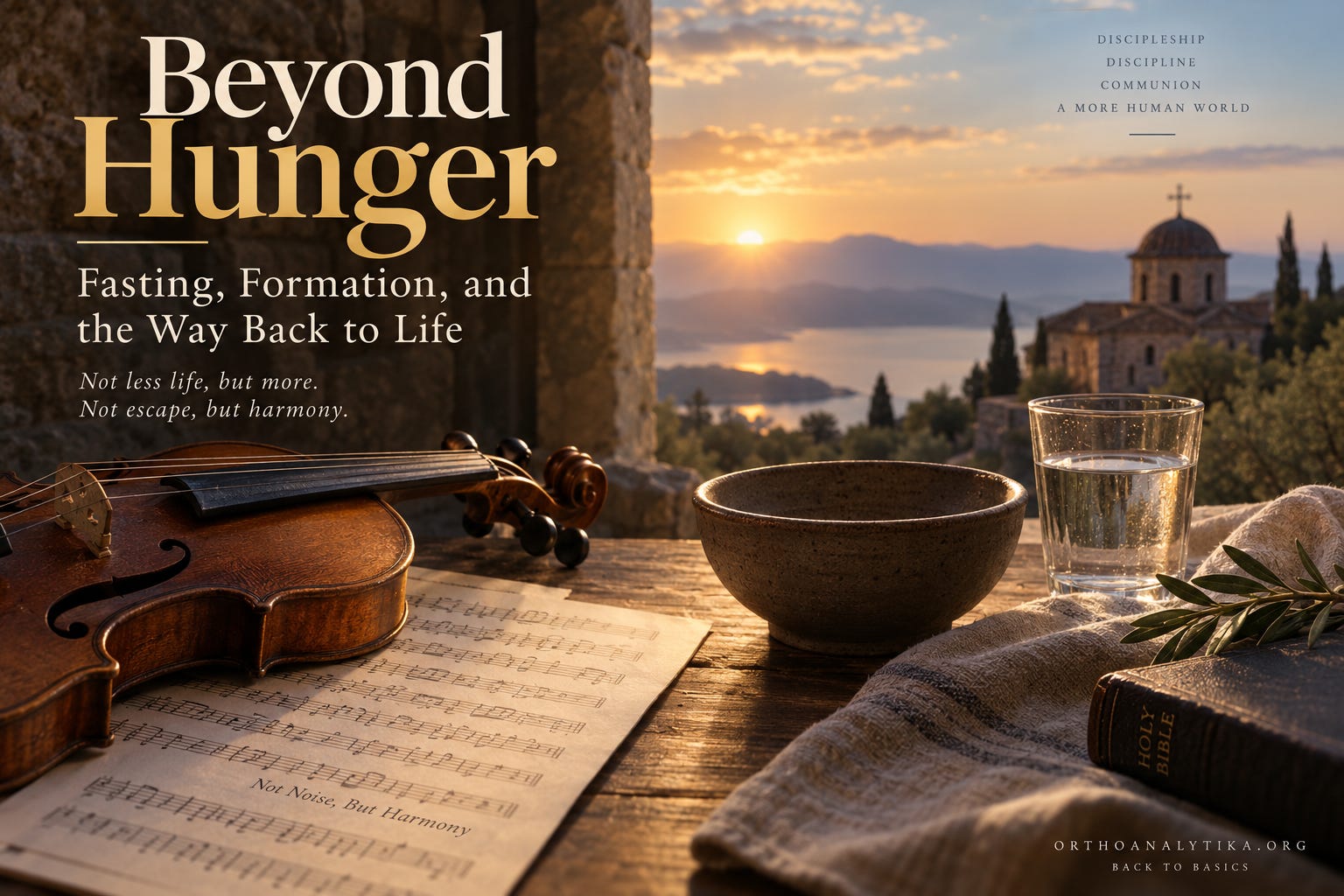
One way to understand this is through music. Sound was made good, but with the potential to be made better; to serve higher purposes. Music is one such purpose.
Music takes tremendous human ability and freedom. A musician can produce an almost limitless number of sounds. But good music does not result from musicians exercising all their abilities whenever they feel like it. Music requires discipline. It requires restraint. It requires the musician to learn that simply because he can play a note does not mean that he should play it.
One of the first skills a musician has to develop is the ability to listen. He learns to distinguish pitch, tempo, dynamics, consonance, and dissonance. Before he can contribute well, he has to learn to hear what is actually happening around him.
Then he learns to match pitch and tempo. If everyone insists on his own pitch or his own tempo, the result is not freedom. It is noise. But once musicians have learned to listen and to discipline themselves, they can begin to sing or play together.
And then something even more beautiful becomes possible: harmony.
To harmonize, the musician has to understand his own part and how it contributes to the whole. Sometimes his part is prominent. Sometimes it is barely audible. Sometimes he sings loudly. Sometimes softly. Sometimes the most important thing he can do is rest and allow someone else to carry the melody.
This requires ability, but it also requires humility, submission, attention, and self-control. A musician may have tremendous technical skill and still ruin an ensemble because he sings too loudly, rushes the tempo, or insists on drawing attention to himself. The mature musician does something much harder: he submits his ability to the needs of the music.
When musicians learn to listen, develop their abilities, and play their parts well, the sum becomes greater than the parts. Sound is transformed into beauty.
This gives us a way of understanding fasting. Fasting is not just about what we do or don’t eat or when we eat. Food is one application of a skill and need that is much more general: learning to govern ourselves so that we can participate in something greater than ourselves.
St. Paul uses the language of athletic training rather than music, but the principle is very similar. He writes, “Every athlete exercises self-control in all things,” and then says of himself, “I pommel my body and subdue it” (1 Corinthians 9:25, 27). The athlete disciplines his strength so that it can accomplish something. The musician disciplines his ability so that it can become music. And the Christian learns to discipline his desires so that his whole life can become an offering to God.
I. Beyond Hunger: The Sacred History of Fasting
The Bible begins not with scarcity, but abundance. In the Garden of Eden, Adam and Eve were surrounded by provision. Genesis tells us that God made “every tree that is pleasant to the sight and good for food” (Genesis 2:9). There was no hunger, no anxiety, no competition.
There was only one act of restraint. God told them not to eat from the tree of the knowledge of good and evil (Genesis 2:16–17).
That command was not arbitrary. It was an invitation. It trained trust. It trained restraint. It trained discernment. In other words, it was a form of fasting.
The Fall did not happen because Adam and Eve were hungry. It happened because desire was granted authority. Genesis tells us that the fruit was “good for food, a delight to the eyes, and to be desired to make one wise” (Genesis 3:6). Desire outran obedience to God; appetite replaced trust in God. Because they would not fast from that fruit, humanity lost access to the Tree of Life (Genesis 3:22–24).
And that pattern does not stop there.
Immediately after the Fall, we see it again with Cain. God warns him before he sins. He says, “Sin is crouching at the door; its desire is for you, but you must master it” (Genesis 4:7). Cain is not powerless. He is untrained. He does not pause. He does not restrain himself. Power without holiness becomes violence (Genesis 4:8).
Cain’s failure does not remain personal. His descendants boast of violence and the whole line of Cain is beset with sin (Genesis 4:23–24). What began as unrestrained appetite becomes culture. Disorder spreads.
Then there is Esau.
Esau comes in hungry from the field. Hunger is real. But instead of waiting, instead of trusting, he trades his birthright for a bowl of soup (Genesis 25:29–34). Scripture concludes bluntly, “Thus Esau despised his birthright” (Genesis 25:34). The future is sacrificed to the present moment. Desire had been granted authority and Esau suffered for it.
This is a recurring biblical warning: a lack of self-control leads to ruin. As Proverbs puts it, “A man without self-control is like a city broken into and left without walls” (Proverbs 25:28).
But the story does not end with Adam.
At the beginning of His public ministry, Christ goes into the wilderness and fasts for forty days. And then He becomes hungry (Matthew 4:1–2). The temptation that follows should sound familiar. The devil says, “If you are the Son of God, command these stones to become loaves of bread” (Matthew 4:3). Christ has the power to do it. Hunger is not sinful. Bread is not sinful. The temptation is to allow appetite to determine how divine power will be used.
Adam was surrounded by food and would not refrain from the one thing God had withheld. Christ is surrounded by stones, hungry after forty days, and refuses to turn even one of them into bread apart from the will of His Father. His granted no authority to human weakness or desire. Adam allows appetite to become authority. Christ restores appetite to its proper place under obedience.
And this is crucial for understanding Christian fasting. Fasting is not a technique for saving ourselves through self-control. Christ saves us. But Christ restores our humanity, and part of that restoration is learning again how human desire is supposed to work; to submit the appetites as they themselves are being retrained to incline us only toward the good, the beautiful, and the true.
God’s response to our problem is not to remove desire. He does not make us less human. Instead, He heals us and gives us training. Fasting is not punishment. It is medicine. It is a habit that helps restore the image that has been distorted (1 Corinthians 9:25–27; Colossians 3:9–10).
II. Fasting Beyond Food: Purifying the Mind, Mouth, and Motions
One of the most important things to understand about fasting—and about the Christian life—is that we are not changed simply because we have agreed that Orthodox ideas are the best. Scripture tells us, “Be doers of the word, and not hearers only” (James 1:22). Ideas alone do not transform us. We are formed by sanctifying repetition, habit, rhythm, and environment.
This is why the Church does not simply tell us to be holy. She gives us practices—rituals—that shape us slowly and faithfully over time (Acts 2:42; 1 Timothy 4:7–8).
Tito Colliander begins Way of the Ascetics with essentially this point: “Faith comes not through pondering but through action. Not words and speculation but experience teaches us what God is” (Colliander, ch. 1).
Fasting is one of the Church’s most basic formative practices.
In fact, Colliander calls fasting a teacher. The Church, he says, has given us a teacher that can reach us wherever we are: “Do you wish to know his name? It is holy fasting.” He continues: “We learn to do this through obedience, and obedience we learn through practice. The best form of practice is that provided by the Church in her prescribed fast days and seasons” (Colliander, ch. 12).
That is why fasting works.
Scripture tells us that “each person is tempted when he is lured and enticed by his own desire” (James 1:14). Adam and Eve did not fail because they lacked information. They failed because they did not restrain their desire. Again, they granted desire authority it did not deserve.
Fasting works below the level of argument. It slows impulse. It interrupts bad habits. It retrains instincts. Many of us discover, when fasting begins and we are forced to slow down, how often we reach automatically for food, our phones, or the distraction of shiny things. Fasting gently reminds us that desire does not have to be obeyed immediately.
It teaches us the spiritual equivalent of what the musician learns: not every impulse needs to become a note.
Colliander makes the same point in remarkably practical terms. He tells us to begin with the small desires because they are connected to the larger ones: “If you have the urge to drink two cups of coffee, drink only one!” The point is not that the second cup of coffee is evil. The point is learning that the desire itself does not have to be obeyed. He describes this as learning, with God’s help, to silence our “loud-voiced will” (Colliander, ch. 5).
Fasting also trains the mind. Christ tells us, “Where your treasure is, there will your heart be also” (Matthew 6:21). Attention is a form of appetite. That is why fasting is traditionally paired with prayer, Scripture, and silence. If we fast from food but continue to feed outrage, anxiety, or constant stimulation, fasting will feel frustrating. Desire simply relocates; it can’t just be about food.
This is another place where the musician helps us. The musician cannot play well unless he learns to listen. He has to stop producing sound long enough to hear the music around him. The Christian life requires the same kind of attention. We cannot learn to love God and our neighbor if we never learn to listen to them.
Fasting trains the mouth as well. Scripture warns us that “the tongue is a small member, yet it boasts of great things” (James 3:5). Hunger often reveals impatience in speech. This is not failure—it is revelation. Fasting shows us what needs healing.
And fasting trains the body. Scripture urges us to “present your bodies as a living sacrifice” (Romans 12:1). Formation is embodied. Waiting, standing, refraining, tolerating mild discomfort—these things teach patience without lectures.
Again, think of the musician. Years of scales, breathing exercises, repeated passages, and learning when not to play eventually become something that looks effortless. The discipline has entered the body. The musician no longer has to reason through every note. His instincts have been formed.
Ascetic practice works in much the same way. We practice patience so that we can become patient. We practice restraint so that restraint can become natural. We practice gratitude so that gratitude becomes our instinctive response to the world.
Colliander actually uses this same analogy. He warns that just as a pianist can practice so zealously that he injures his hands, ascetic practice can become distorted through excess. Fasting, obedience, self-discipline, watchfulness, and prayer are all forms of practice, he says, and practice must be undertaken soberly, without exaggeration (Colliander, ch. 21).
The psalmist prays, “Search me, O God, and know my heart” (Psalm 139:23). Fasting answers that prayer. It reveals impatience, anxiety, and entitlement—not to shame us, but to make repentance honest and possible. Fasting provides just enough stress for our weaknesses to be revealed without causing damage.
And once they are revealed, grace can begin healing them. When desire is retrained through patient practice, fasting stops being a burden and becomes a source of freedom.
III. Eating with Reverence, Fasting with Joy: The Art of Holy Balance
Fasting is not the goal of the Christian life. Communion is.
The problem in the Garden was not eating—we were told to eat (Genesis 2:16); the problem was that we ate without reverence, restraint, and trust.
Christ restores what was lost through obedience, fasting, and the Cross. The Cross becomes the new Tree of Life. In the sacramental life of the Church, we are invited to eat again; but this time we are doing it correctly. Not grasping. Not consuming. But receiving (John 6:51–57; 1 Corinthians 10:16–17). Note that we do not “take” communion; we “receive” it.
This restoration is why Christian fasting always points toward a feast. We fast before receiving the Eucharist. We fast through Lent toward Pascha. We fast through Advent toward the Nativity. The Church teaches us to refrain so that our desires can be pointed toward something good and so that we can learn how to receive.
Scripture reminds us, “Whether you eat or drink, or whatever you do, do all to the glory of God” (1 Corinthians 10:31). Food becomes gift again, not entitlement. As St. Paul says elsewhere, “everything created by God is good, and nothing is to be rejected if it is received with thanksgiving” (1 Timothy 4:4).
Colliander is explicit that the ascetic struggle is a means rather than an end. He compares it to a prescribed cure: however difficult it may be, its purpose is to restore health. Prayer, fasting, watching, and work are tools given to us on the way toward freedom—the freedom in which Adam was created and which is restored to us in Christ (Colliander, ch. 11).
The Fathers give us a beautiful example of this balance.
Dorotheos of Gaza tells of a holy elder who became ill and could eat very little. His brother prepared food for him, but instead of honey accidentally poured rancid linseed oil over it. The elder tasted it and said nothing. He ate quietly and even accepted a second helping. Only when the brother discovered what he had done did he realize why the food had tasted so terrible. Horrified, he blamed himself for what had happened. The elder gently reassured him: if God had wanted him to eat honey, the brother would have given him honey (Dorotheos of Gaza, 146–47).
Do you see the freedom here? The elder was not ruled by appetite or comfort. He was free to ignore his primal desires and choose love.
That is the point of Christian asceticism. A person who has to satisfy every appetite is not free. A person who cannot tolerate inconvenience without becoming angry is not free. A person whose hunger immediately turns into cruelty toward the people around him has not yet learned what fasting is supposed to teach.
Christ therefore warns us not to fast with gloom or pride (Matthew 6:16–18). And here Colliander gives us a useful diagnostic. If our ascetic discipline produces “overstrain, intolerance and self-righteousness,” something has gone wrong. He says that if we do not find in ourselves the fruits of “love, peace, joy, moderation, humility, simplicity, uprightness, faith and patience,” then our work has been in vain (Colliander, ch. 21).
That is a much better measure of a fast than whether we successfully avoided some kind of milk derivative.
St. Paul writes, “All things are lawful for me, but I will not be enslaved by anything” (1 Corinthians 6:12).
Colliander describes fasting accordingly as “a step on the road of emancipation and an indispensable support in the struggle against selfish desires.” But he immediately counsels moderation: fasting must not weaken the body excessively, should not be undertaken recklessly, and, like every discipline, “demands practice” (Colliander, ch. 20). Thus moderation and balance are themselves seen to be both beautiful and beautifying.
Conclusion: From Noise to Music
So let’s return to music.
Imagine a gifted but undisciplined musician sitting down with an orchestra.
The conductor feels like a restriction. The score feels like a restriction. Tempo feels like a restriction. The other musicians feel like restrictions. Why can’t I play what I want? Why can’t I play when I want? Why can’t I play as loudly as I want? I could own this show!
But the mature musician sees those same things very differently.
The score gives his playing meaning. The conductor helps hold the ensemble together. Tempo allows his notes to meet the notes of others. The other musicians do not diminish his freedom; they make possible a kind of beauty he could never create alone.
And even the rests matter. Sometimes faithfulness means sounding the note. Sometimes faithfulness means remaining silent so that another voice can be heard.
That is the kind of freedom fasting teaches.
We were created as God’s image and given dominion within His creation (Genesis 1:26–28). We were made to take the tremendous possibilities of the world and cultivate them into something good, harmonious, and beautiful. We were made, as St. Peter puts it, to be a “royal priesthood” offering the world back to God in thanksgiving (1 Peter 2:5, 9).
Sin turns that freedom into noise. Every appetite demands to be heard. Every desire wants to become a note. Every person insists on his own tempo.
Christ restores the pattern in us.
And He restores the pattern in us so that we, as His imagers, can once again do what we were created to do: take the possibilities of the world entrusted to us and work them into something better; something harmonious and beautiful that glorifies God and serves our neighbor.
Through prayer, fasting, worship, repentance, and the other disciplines of the Christian life, God teaches us how to hear His pattern again, submit ourselves to its movements, and spread it.
Fasting teaches us to listen. It teaches us restraint. It teaches us when to act and when to wait. It teaches us to want the right things, in the right way, at the right time. Not so that we can escape the world, but so that we can finally participate in it properly. Not so that we can become impressive ascetics, but so that we can become capable of communion and love.
When musicians devote themselves to listening, discipline, and playing their parts well, something happens that none of them can accomplish alone: sound becomes music.
That is an image of the Church, and fasting helps condition us towards it. God is not teaching us merely how to say no; He is teaching us how to become part of the deeper music.
Works Cited
Colliander, Tito. Way of the Ascetics: The Ancient Tradition of Discipline and Inner Growth. Translated by Katherine Ferré. Crestwood, NY: St. Vladimir’s Seminary Press, 1981.
Dorotheos of Gaza. Discourses and Sayings. Translated by Eric P. Wheeler. Cistercian Studies Series 33. Kalamazoo, MI: Cistercian Publications, 1977.