

We do not have to wait until we feel generous to begin practicing generosity. Like prayer and fasting, disciplined giving can reveal the fears and attachments that limit our freedom to love. Fr. Anthony reflects on tithing, almsgiving, work, and receiving help as opportunities to cooperate with God’s grace—and to turn the good entrusted to us into something better.
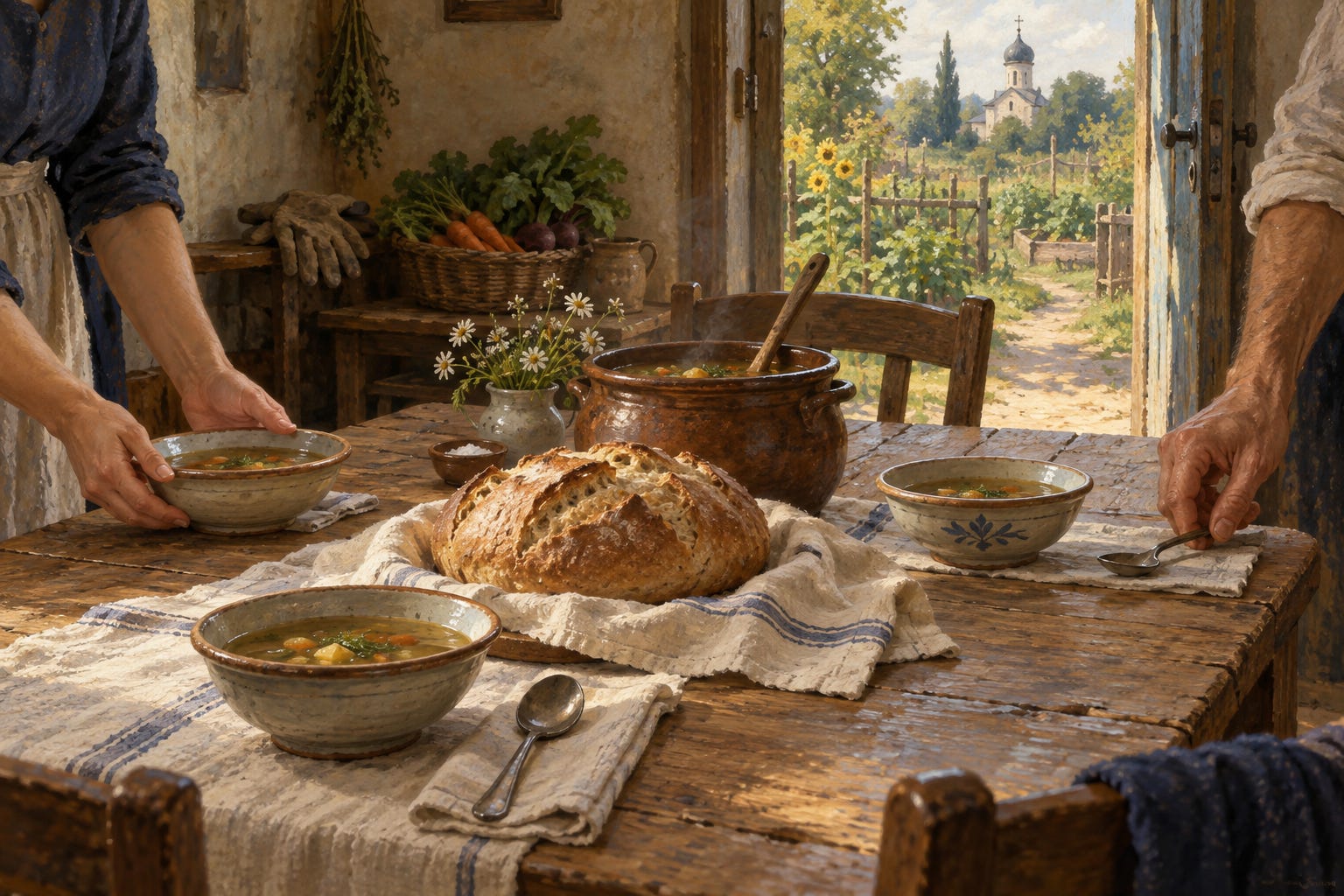
Asceticism: Tithing and Almsgiving
Learning to receive with thanksgiving and give with love
The six-part framework below is adapted from Fr. Andrew Stephen Damick, “6 Reasons Why Tithing Is Good for an Orthodox Parish,” October 27, 2015. Fr. Andrew deserves the credit for the six reasons; the reflections, adaptations, and any trouble they cause are my responsibility. —Fr. Anthony
What is our relationship with money teaching us to love?
Remember the setting: God made and calls us to be His imagers in the world, receiving what He has made good and working in Him to make it better—to cultivate, heal, beautify, and then offer it back to Him with thanksgiving. To cooperate with His grace in this work, we need to develop self-control so that our appetites, fears, and desire for comfort do not point us in the wrong directions and mar even our best-intended renderings. Asceticism trains us for this calling through concrete practices that expose our weaknesses and help us grow in the freedom to love.
Prayer, fasting, and giving belong together in ascesis. Each involves offering something real to God: our attention, our appetite, our time, our possessions. Through these practices, we learn to receive His gifts with thanksgiving and use them with love.
Money is particularly revealing, in part, because it gives us options. It can buy comfort, convenience, pleasure, and a measure of security. It may not buy happiness, but it’ll buy you a boat. As with every moment, every dollar carries possibilities for what we might do with it. Giving money away means surrendering some of those options. We may discover that we are more attached to imagined possibilities than we thought.
As we discussed with fasting, an ascetic practice stresses the system enough to expose our weaknesses. When we are comfortable, and everything is going our way, some of those weaknesses can remain hidden. Fasting may reveal how impatient we become when an appetite goes unsatisfied. Giving, and even the preparatory discipline of budgeting, may reveal how anxious we become when we seem at risk of surrendering some of our financial freedom. Neither fasting nor giving automatically produces virtue. These practices us see where we need healing and gives us an opportunity to respond differently—with prayer, repentance, and practice.
Discovering these weaknesses is part of the work. We don’t begin an ascetic practice because we have already been healed. We begin because we need healing.
The point is not to overwhelm ourselves or prove how much we can endure. The discipline should challenge us in a way that helps us grow.
As with prayer and fasting, the outward act matters and bears other fruit, but we must also attend to what is happening in our hearts. We can give money and become proud of our generosity. We can give to the parish and begin to think that our gift entitles us to get our way. We can help someone and resent them for not being sufficiently grateful.
So our question is more than “How much should I give?” It is also “How can I learn to give freely, gratefully, and with love?” Because God loves a cheerful giver (2 Corinthians 9:7).
1. Giving participates in our healing
Fr. Andrew begins with salvation (theosis), and that is where we should begin as well.
We want to become like Christ. We want our lives to become more generous, more patient, more courageous, and more loving. We want to be free to do what is good.
Our attachment to money can interfere with that freedom. We may know that someone needs help, yet find ourselves inventing reasons why helping is someone else’s responsibility. We may trust God in principle while arranging our lives as though everything depends on our maintaining complete control.
Giving brings these habits into the light. It gives us something concrete to work on.
We certainly do not purchase grace by making a donation. God is already generous toward us. Our giving is a response to His generosity and an opportunity to cooperate with His healing.
Nor do we need to wait until we feel generous. We practice generosity so that, with God’s help, generosity becomes more natural to us. That is familiar territory: we pray when prayer is difficult, and we fast when our appetites would prefer otherwise. So it is with giving; we budget so that our giving becomes part of the rituals that heal and form us.
When we struggle to give well, as everyone does, specific weaknesses are exposed to the healing ministrations of Christ. This is part of the process; it does not mean that we have failed.
2. Regular giving trains our priorities
Our spending expresses our priorities, and repeated spending helps establish them. What we continually invest in receives our attention and becomes part of the life we expect to have. Our habits form us. Many of our habits with money train us to think and react as consumers; habits of generosity help retrain us in love.
Christ tells us that where our treasure is, our heart will be also (Matthew 6:21). That gives us something to examine, but also something to practice. We can begin putting our treasure where we want our hearts to learn to dwell.
At Christ the Saviour, we encourage sacrificial giving, with tithing as a useful benchmark. A tithe is ten percent of income. It gives us a definite point of reference rather than leaving generosity at the level of good intentions.
Ten percent represents different sacrifices in different households. For some, it is a substantial challenge. Others can give considerably more. Someone struggling to meet basic needs may need a different starting point and pastoral guidance.
The aim is faithful growth in generosity and justice. Caring for children, supporting dependents, and meeting necessary obligations are themselves responsibilities before God. We should bring these commitments into our understanding of faithful stewardship. Over time, we can become more intentional about our spending, simplifying our lives and reducing avoidable expenses so that we have greater freedom to support the Church and help our neighbors.
A useful beginning is to make giving deliberate and regular. Include it in the way you plan your life, and revisit that plan prayerfully as your circumstances change.
3. Giving belongs within Orthodox asceticism
We readily recognize prayer rules and fasting disciplines as Orthodox practices. We should be just as ready to recognize disciplined generosity.
Our bank accounts belong within our spiritual lives. So do our working hours, our purchases, our savings, and the things we hope eventually to afford. All of these involve decisions about what we value and whom we serve.
Tithing is a useful discipline within that larger offering. It does not divide our income into God’s ten percent and our ninety percent, with no further questions asked. Our whole life belongs to God, including our responsibility to use what we retain wisely and lovingly.
We can also distort this practice. A person may give precisely ten percent and become contemptuous of someone who gives less. Another may give a large amount and expect influence in return.
As with fasting, we need both the practice and the right direction for the practice. Generosity should cultivate humility, thanksgiving, and love. If it is cultivating pride or a sense of ownership over other people, we need to bring that into confession and pastoral conversation.
4. Our gifts become opportunities for ministry
Money given to the parish supports concrete work.
A full-time priest has time available for worship, teaching, visiting, pastoral care, and responding to emergencies. A maintained building provides a place where people can gather, pray, learn, and receive hospitality. Utilities, insurance, and supplies help make that possible.
At Christ the Saviour, we have enjoyed tremendous growth since we committed ourselves to supporting a full-time priest. Our regular giving helps sustain the conditions in which that ministry can continue. Connections like this are worth remembering when giving feels abstract. A gift helps make someone else’s encounter with the Church possible.
And parish support is only part of our responsibility. We are also called to help people in need. Fulfilling a pledge does not mean that we have finished being generous or helping our neighbor.
5. Dependable generosity helps a parish plan and serve
Regular giving allows a parish to make responsible commitments.
It helps us maintain what we have, support ongoing ministry, and prepare for needs we can reasonably anticipate. It also gives us greater freedom to respond when an unexpected need arises.
Exceptional gifts are a blessing. Dependable giving provides the foundation for ordinary parish life. Both deserve gratitude, but we should understand the difference when planning.
Generosity does not eliminate every financial difficulty. Buildings need repairs, costs change, and families experience hardship. A generous parish still needs careful budgeting, accountability, and honest communication.
But dependable support allows us to devote more attention to the people and work entrusted to us. That is a good reason to make giving a regular practice rather than something we do only in response to a crisis.
6. Giving helps us become a community of mutual care
A parish teaches through its habits as well as through its words.
At Christ the Saviour:
We encourage sacrificial giving, with tithing as a useful benchmark.
We do not take up collections during services.
We do not have a price list for services, sacraments, or even candles.
These practices are sustained by voluntary generosity. The costs are real, and together we take responsibility for meeting them.
We want people to encounter the Church as a community of worship and love. Someone’s belonging, voice, and access to pastoral care do not depend on the size of a contribution.
That means there is room for people to give and room for people to receive. At different times, the same person may be doing more of one than the other. Throughout it all, we remain members of one body.
Christ identifies love for one another as a mark of His disciples (John 13:35). The way we handle money should help make that love visible.
Worship and work as offering
The asceticism associated with money extends beyond our parish giving. It includes how we spend our time, how we work, and what we do with the fruits of our labor.
Worship itself involves an offering. We give time and attention. We may pay for gas or arrange transportation. Coming to church may mean giving up paid work, rest, or other things we could have done with those hours. There are real costs involved. Making room for worship helps establish what our lives are for.
Our work can also become an offering, and good work has a double benefit.
First, through the work itself, we take what God has given us and help turn the good into something better: we cultivate a garden, repair a house, prepare a meal, teach a child, or bring order to something neglected. This belongs to our calling as a royal priesthood—to receive God’s gifts, work with them faithfully, and offer the fruits with thanksgiving.
Doing this well requires the self-control we have been discussing. We need patience when a task becomes frustrating, diligence when we would rather stop, and humility when someone needs something done differently than we would prefer. Our ascetic disciplines help train us for these ordinary acts of service.
Second, in a reasonably just system, our work may bring us income. That money allows us to provide for our households, sustain the Church, and help our neighbors. We can do good through the work itself and then do further good with what we earn.
Of course, much essential work receives no paycheck, and pay does not always reflect the goodness or value of the work. Caring for children, tending to someone who is ill, and helping a neighbor all participate in this calling. The question is what we are making of the gifts and opportunities entrusted to us.
Almsgiving as mercy
One of the things we can do with those gifts is help someone in need.
Almsgiving directs our attention toward our neighbor. It asks us to notice another person and respond with mercy. Money is an important means of doing this. Our time, food, transportation, patient attention, and help connecting someone with appropriate resources can also become expressions of that same mercy.
Here again, the practice can expose our weaknesses. We may resent the interruption, fear being taken advantage of, or want to decide how the person should respond. We may discover that we are willing to help as long as helping leaves us feeling appreciated and in control.
That gives us something to work on. We can learn to respond thoughtfully and generously while attending to the actual needs of the person before us.
We should give with discretion and respect. A person in need does not owe us a performance of gratitude, and their difficulties are not ours to turn into a story about our generosity. We offer help for their good, allowing the encounter to train us in love.
At Christ the Saviour, parishioners should not give money directly to needy visitors on parish grounds.
We coordinate that assistance through Fr. Anthony and Gregory. Please welcome the person and connect them with us. If you want to contribute toward helping a visitor, you can entrust that contribution to Fr. Anthony or Gregory.
Learning to receive
Receiving can be an ascetic struggle, too.
We may find it easier to be the person who helps than the person who needs help. Accepting assistance can expose our pride, fear, or attachment to independence.
There is no shame in having needs. We receive our lives from God, and throughout those lives we depend upon other people.
Learning to receive gratefully allows others to exercise love. It also reminds us that we belong to a community in which care moves in more than one direction.
Both giving and receiving can become occasions of grace.