

Galatians 2:16-20; Mark 8:34-9:1
We have two incredibly powerful readings today, and they belong together. In the Epistle, St. Paul says, “I have been crucified with Christ; it is no longer I who live, but Christ lives in me.” And in the Gospel, our Lord tells us, “If anyone wishes to come after me, let him deny himself and take up his cross and follow me.” This is the Sunday after the Exaltation of the Cross, and the Church is teaching us what the Cross means for us. The Cross is not simply something that happened to Jesus Christ two thousand years ago. The Cross reveals the shape of the Christian life. Christ was crucified for us, but now we are called to be crucified with Him. He took up His Cross, and now He tells us to take up ours and follow Him.
To understand just how radical this is, it helps to go back to the beginning. Human beings were created as the images of God in this world. God created the world good, and He entrusted it to us so that we could cultivate what He had made, taking what was good and bringing it toward greater goodness, beauty, and glory in the service of God and our neighbor. That is part of what it means to bear the image of God. We were created to participate in God’s work in the world.
But both we and the world suffer from the consequences of sin. Because our own hearts are divided, even our best intentions can go sideways. We try to do good, but selfishness becomes mixed with love. Pride becomes mixed with service. Fear becomes mixed with prudence. The desire to help becomes mixed with the desire to control. We were created to cultivate the world toward glory, but because we ourselves are disordered, our work in the world so often becomes disordered as well.
And so God gave us the Law.
The Law was a gift. We should never speak as though God made some sort of mistake in giving it. The Law taught God’s people what holiness looked like. It protected them from some of the worst consequences of their fallen instincts. It restrained idolatry, violence, exploitation, and selfishness. It ordered their common life. It distinguished between what was clean and unclean, between what led toward life and what led toward death. And it prepared and preserved a people in whom the Messiah could come.
But there was something the Law could not do. The Law could reveal holiness and train God’s people in it, but it could not itself heal and transform fallen human nature. It could restrain sin, but it could not heal everything within us that wanted to sin. It could command us to love God and our neighbor, but it could not, by itself, transform us into people for whom love had become natural and instinctive. The Law could protect. It could teach. It could reveal. It could prepare. But it could not give life.
And that is why what St. Paul says today is so radical: “I have been crucified with Christ; it is no longer I who live, but Christ lives in me.” Christianity is not God giving us a better version of the Law. Christianity is God giving us His life.
And this helps us understand something wonderful about Orthodoxy. Christianity really is a Way. In fact, before “Christian” became the ordinary name for the followers of Christ, the book of Acts repeatedly describes Christianity simply as “the Way.” And that is what we have received. Orthodoxy is not just a collection of correct ideas about God. It is not simply a set of propositions that we agree with. It is a holistic and all-encompassing way of life, received and developed within the Church under the guidance of the Holy Spirit, for our salvation and theosis.
For two thousand years, the Church, guided by the Holy Spirit, has received, developed, adapted, vetted, and handed down services, prayers, fasting disciplines, feasts, prostrations, icons, hymns, prayer rules, and countless other practices through which the life in Christ is learned and lived. We have a way of ordering the day. We have a way of ordering the week. We have a way of ordering the year. We have ways of training the mind, the body, the appetites, the imagination, and the heart. It is an entire way of life.
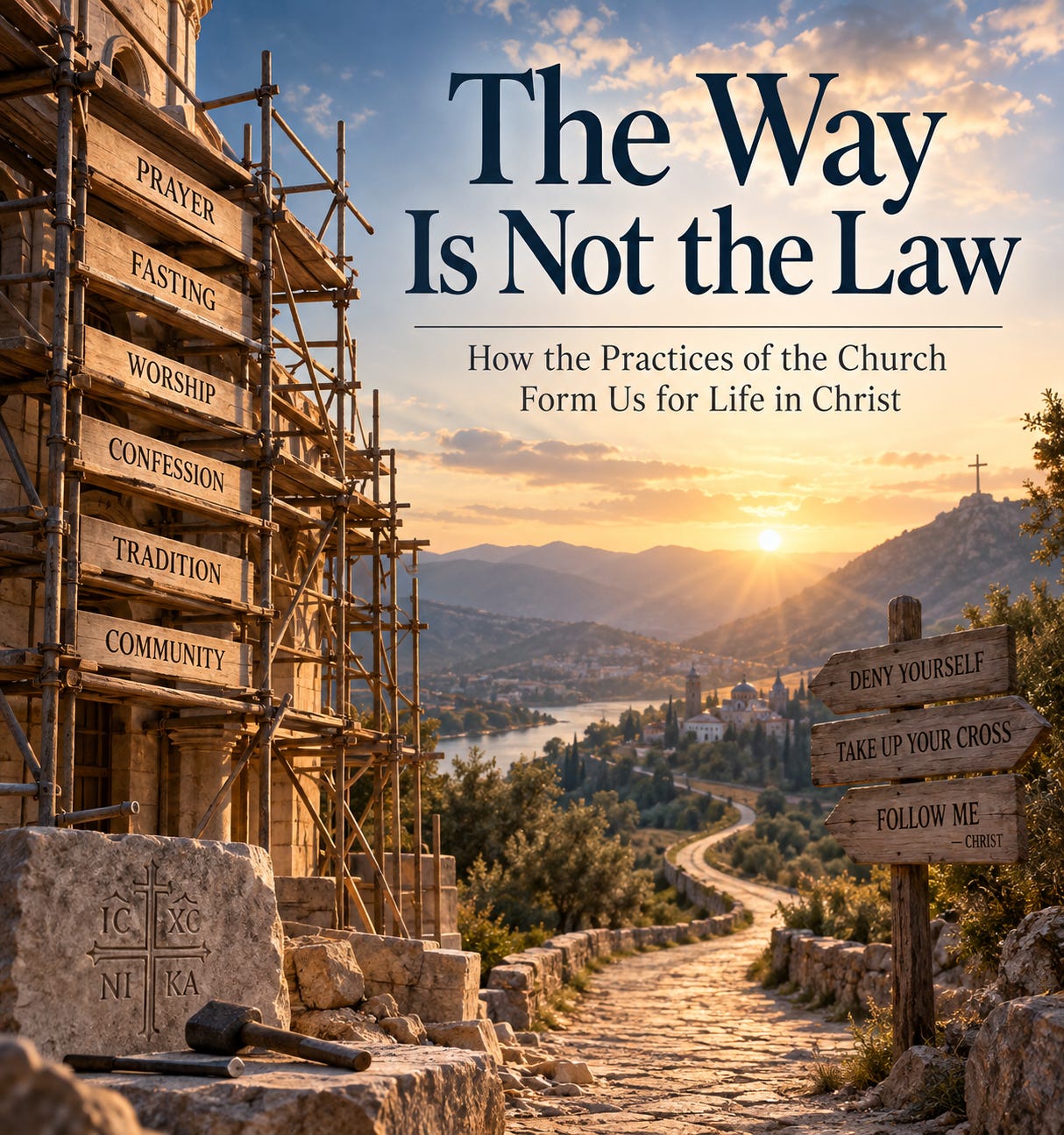
These traditions provide a kind of scaffolding for our life in Christ. The scaffolding is not the building, nor does it build the building. But it provides the structure within which the work can take place. In much the same way, the practices of the Church dispose us to cooperate with the grace of God, giving shape and structure to repentance, prayer, self-control, worship, gratitude, attention, and love.
And when someone is raised within that life, something beautiful can happen. A little child does not begin by reading a theological treatise about the Cross. He learns to make the sign of the Cross. He does not begin with a sophisticated theology of repentance. He sees his parents ask forgiveness, and he learns to ask forgiveness. He learns to fast a little before he learns to fast a lot. He learns to stand in church. He learns to kiss an icon. He learns the hymns before he understands everything they mean. He learns that there are times to feast and times to fast, times to stand and times to kneel, times to speak and times to be silent.
Of course, being raised Orthodox does not guarantee that any of this formation will happen well. Traditions can be neglected, misunderstood, or emptied of their meaning. But at their best, they provide a pattern of formation appropriate to each stage of life.
And as that child grows, the Church grows with him. At every stage of spiritual development, the Way is there, working with the grace of God to heal what sin has damaged and to make virtue increasingly natural and instinctive. Things that begin as external practices gradually become internal dispositions. We practice reverence until we become reverent. We practice repentance until repentance becomes more natural. We practice generosity until generosity becomes less frightening. We practice forgiveness until mercy becomes increasingly instinctive.
That is extraordinary. That is formation. That is what a healthy Christian culture can do. It forms us before we even realize that we are being formed.
But many of us did not grow up that way. Many of us came to Orthodoxy later in life. And that creates a particular challenge for us. Instead of having twenty or thirty or forty years for these things to become part of us gradually and organically, somebody hands us the whole thing at once. Here is your prayer rule. Here are the fasting rules. Here is your prayer rope. Here is the liturgical calendar. Here are the services. Here are the prostrations. Here are the canons. Here is how you prepare for Communion. Here are the saints you should read. Here is how you arrange your icon corner. Here are two thousand years of Orthodox tradition. Welcome to the Church!
And because we love Christ, and because we recognize something beautiful and true here, we want all of it. That is a good desire. We should want to enter deeply into the life of the Church. Many of us came to Orthodoxy precisely because we had already discovered that good intentions were not enough. We loved God. We wanted to serve Him. But we also knew the experience St. Paul describes elsewhere: I want to do what is good, and somehow things still go sideways. We recognize that we need these traditions, these practices, these scaffoldings.
But right there we encounter a tremendous temptation. We can take the Way that was given to bring us into the life of Christ and turn it back into a law.
And this is exactly the sort of thing St. Paul is warning us about. He says, “If I build again those things which I tore down, then I prove myself a transgressor.” We can take fasting and prayer and prostrations and services and all the other good things the Church gives us and begin measuring our righteousness by them. Did I keep the fast correctly? Did I say all of my prayers? Did I make enough prostrations? Did I attend all the services? Am I wearing the right thing? Am I reading the right books? Do I look Orthodox enough? Do I sound Orthodox enough?
And eventually the means by which Christ is healing us become ends in themselves.
There is another version of the same temptation that is especially attractive to converts. Because we receive so much at once, we can begin to approach the Orthodox life as something to master. We master the prayer rule. We master the fasting rules. We master the services. We master the theology, the canons, the calendar, and the customs. There is always another book to read, another service to learn, another ascetical practice to adopt.
But the Way was not given to us primarily so that we could master it. It was given so that, through it, Christ could reshape us.
There is a tremendous difference between those two approaches. I can master information while remaining exactly the same person. I can learn all sorts of things about fasting while remaining gluttonous in other parts of my life. I can know the services while remaining inattentive to the people standing next to me. I can read the Fathers while remaining proud. I can become extremely knowledgeable about repentance without actually repenting.
The proper posture toward the Way, therefore, is not anxious acquisition but patient immersion. We enter deeply into the life of the Church and allow its practices, through grace and over time, to conform us to Christ.
And there is a tremendous irony here: our determination to master the Orthodox life can actually make us harder to form. Formation requires humility—the willingness to be corrected, redirected, slowed down, and shaped according to a wisdom and timetable other than our own. If we become rigid, the very traditions meant to reshape us can become tools for defending the shape we have already chosen for ourselves.
Worse yet, once the practices become ends, they become wonderfully convenient ways of judging everyone else. I am fasting correctly; why isn’t he? I am at this service; where is she? I follow this prayer rule; why doesn’t everyone else? I know the canons. I know the Fathers. I know how Orthodox people are supposed to behave. And before long, the beautiful Way that was given to heal our pride has become fuel for our pride.
That is the Pharisaical temptation. And it is worth remembering that our Lord had tremendous patience with prostitutes, tax collectors, and people whose lives were obviously broken. They could see that something was wrong. They knew that they needed mercy. But He was extraordinarily severe with the Pharisees because their religious accomplishments had become the very thing that prevented them from recognizing their need for mercy. They had become good at the religious system, and because they were good at it, they thought they were good.
That is a danger for us as well. If I think that fasting, saying my prayer rule, wearing my cross, using my prayer rope, knowing the services, or following all the traditions makes me righteous, then the very practices intended to lead me toward repentance can convince me that I no longer need it. Then we become rigid. We become quick to correct. We become quick to condemn. And eventually we can become the sort of people who know everything about Orthodoxy except how to love.
There is another reason we need humility here. The Orthodox treasury is enormous. None of us is working on everything at once, nor should we be. At a particular stage of our life, under the guidance of the Church and our spiritual father, one of us may need to concentrate especially on fasting and self-control. Another may need to concentrate on learning to pray consistently. Another may need to learn generosity. Another may desperately need to learn patience with a husband or wife, or gentleness with children, or forgiveness toward someone who has wounded him.
Their spiritual lives may look very different from the outside, and both may be faithfully cooperating with the grace of God.
That means I need to be very careful about measuring someone else’s progress according to the particular work God is presently doing in me. I do not know everything that God is presently forming in that person. I do not know the counsel he has received. I do not know the wounds that are being healed or the virtues that are being strengthened. What God is using as medicine for me at this moment does not automatically become the prescription I should write for everyone else.
So be patient with one another. And be patient with yourself—not patient with sin, but patient with the process by which God is healing you from sin.
Be patient with the tempo of God’s work in you.
You cannot take a shortcut to perfection.
That is difficult for some of us to accept. We discover the treasury of Orthodoxy and immediately wonder what we can read, what discipline we can adopt, what practice we can master to accelerate the process. But there is no advanced spiritual technique that allows us to skip humility, repentance, patience, and mercy. Sanctification takes time because God is not merely teaching us new information. He is healing and transforming persons.
None of this diminishes the importance of the practices themselves. Fasting, prayer, prostrations, worship, confession, the liturgical calendar, and the traditions of the Church matter precisely because they form us. The mistake is not taking them seriously. The mistake is forgetting what they are for.
The Way is not a substitute for following Christ. It is the way we learn to follow Christ.
Fasting is not the destination. Fasting teaches me to deny myself so that I can follow Christ. Prayer is not the destination. Prayer teaches me to turn my attention toward Christ. Prostrations are not the destination. They teach my proud body repentance and humility. The services are not the destination. They gather us together into Christ and teach us to live as His Body. The prayer rope is not the destination. It teaches my wandering mind and heart to call continually upon the name of Jesus.
These things are not “just rules.” They are far more important than rules. They are parts of a divinely ordered way of life through which generations of Christians have learned to take up the Cross and follow Christ. But the moment I turn them into accomplishments by which I establish my own righteousness, I have taken something that belongs to the life of the New Covenant and forced it back into the role of the old Law.
And today’s Gospel gives us the corrective. Christ does not say, “If anyone wishes to come after me, let him master the religious system.” He says, “If anyone wishes to come after me, let him deny himself and take up his cross and follow me.”
Follow me.
That is the center. That is the purpose of everything else.
And notice what happens when we get that right. Christ does not merely teach us how to behave better. He transforms us. This is the glory of what St. Paul is saying: “It is no longer I who live, but Christ lives in me.” The Christian life is not ultimately about making the old person behave himself a little better. It is about the old person being crucified with Christ so that the life of Christ can become active in him. It is not merely behavior modification. It is transformation. It is theosis.
This is what the whole Orthodox way of life is for. Not to create people who are extraordinarily good at being Orthodox, but to create saints.
We fast so that Christ can heal our appetites. We pray so that Christ can heal our attention. We confess so that Christ can heal our self-deception. We worship so that Christ can reorder our loves. We practice generosity so that Christ can heal our possessiveness. We forgive so that Christ can heal our resentment. We take up the Cross so that the old life can die and His life can become ours.
And over time, through the grace of God, something wonderful begins to happen. What once required tremendous effort begins to become natural. Mercy becomes more instinctive. Forgiveness comes more readily. Prayer becomes less foreign. Generosity becomes less frightening. Love becomes less calculating. We begin, however imperfectly, to become the sort of human beings we were created to be.
And now we can return to where we began.
God created human beings as His images in this world. We were made to receive what He created good and cultivate it toward greater goodness, beauty, fruitfulness, and glory. Sin frustrates that vocation because broken people bring their brokenness into the things they touch. The Law could restrain some of that brokenness. But in Christ, God does something greater: He begins healing the people through whom He intends to heal and glorify His creation.
That means the fruit of our formation does not end with us. As Christ heals us, our relationships begin to be healed. The crooked begins to be made straight. Places that had become barren begin to flourish. A husband who is learning patience changes a marriage. A mother who is learning mercy changes a family. A Christian who is being freed from pride changes a parish. A community whose members are learning to forgive, encourage, serve, and bear one another’s burdens becomes a place where wounded people can begin to heal.
We become increasingly capable of doing the work for which humanity was created: receiving the good world God has given us, cultivating it in holiness, and offering it back to Him more beautiful, more fruitful, more loving, and more alive.
That is what the Law could point toward but could never accomplish by itself. The Law could reveal holiness. Christ unites us to the Holy One. The Law could command love. Christ pours His life into us so that we can learn to love. The Law could restrain us from death. Christ takes us through death into resurrection.
And that is why these two readings belong together on this Sunday after the Exaltation. St. Paul says, “I have been crucified with Christ.” And Christ says, “Take up your cross and follow me.”
Brothers and sisters, that is the Way.
Everything the Church gives us—every fast, every feast, every prayer, every prostration, every service, every discipline, every beautiful tradition—is there to teach us how to walk it. So yes, let us learn the traditions. Let us keep the fasts. Let us say our prayers. Let us worship faithfully. Let us take seriously this extraordinary way of life that has been entrusted to us.
But let us receive it patiently. Let us resist the desire to master it and instead allow Christ, through it, to reshape us. Let us be patient with the particular work God is doing in us and equally patient with the work He is doing in our brothers and sisters. And let us never confuse the means with the end.
The goal is Christ. The goal is to be crucified with Him so that He can live in us. The goal is to become by grace what God created human beings to be: His sons and daughters, filled with His life, transformed into people who know how to love—and who, increasingly, love naturally, instinctively, and without reservation.
That is the Way. Let us take up our cross and walk it.