

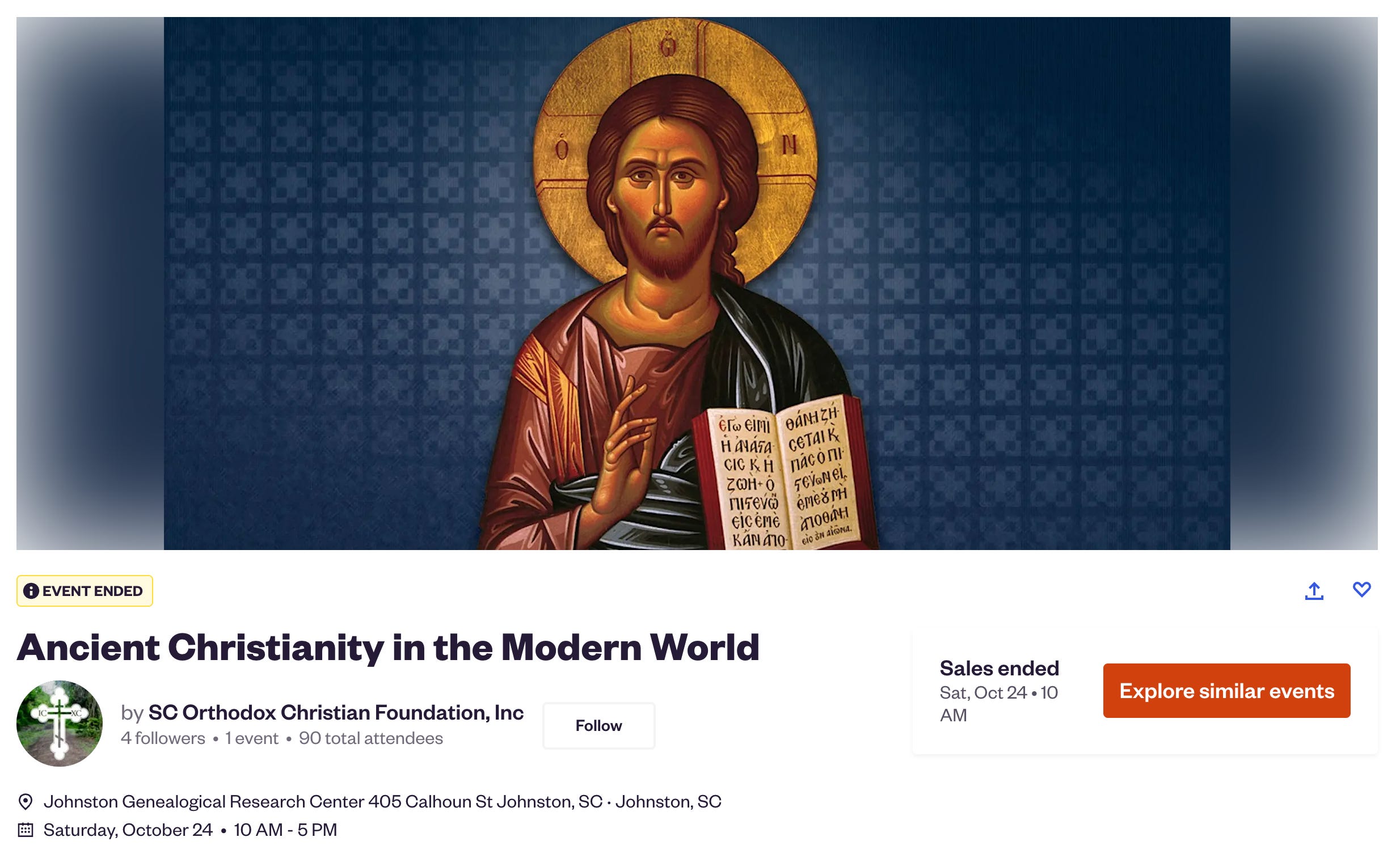
This essay is based on a talk I gave at the retreat, “Ancient Christianity in the Modern World” on 24 October 2026. The keynote speaker was Fr. Stephen Freeman, and the second speaker was Fr. Gregory Rogers.
Music, Creation, and Our Vocation
There is something strange and wonderful about music. Sound is simply part of creation. It depends on matter, movement, time, and the capacity of one thing to affect another. Yet sound was made in such a way that it contains the possibility of music. Strike a note on a good instrument and it is not really alone. Other tones are already implicit within it. Harmonics resonate above and around it. What sounds like one note already contains the possibility of relationship. And human beings hear those possibilities. We recognize pattern. We discover harmony. We learn how one note can prepare for another, how dissonance can create expectation, and how resolution can make sense of what came before. Then we take what was given to us and cultivate it. We make music.
That small miracle tells us something important about creation—and about ourselves. Genesis tells us repeatedly that what God created was good. But “good” does not mean static. Creation contains possibilities. Wheat is already good as wheat, but it can become bread. Bread can feed a hungry person. Bread can become an offering. And through the grace of God, bread offered in thanksgiving can become Eucharist. Creation is good, and part of its goodness is its capacity to be cultivated toward fulfillment.
Human beings were given a particular vocation within that world. We were created in the image of God and commanded to be fruitful, to multiply, to fill the earth, and to subdue it. Because of our fallen experience of power, “subdue” can sound like domination: forcing creation into the shape of our own will. But that is already a corruption of the vocation. Humanity was placed in creation not to exploit it but to discern its nature, its possibilities, and its proper end—and then to shepherd it toward fulfillment.
We were given reason and wisdom so that we could understand the nature of things. We were given prudence so that, having understood them, we could cultivate them rightly. Science does this. Engineering does this. Art does this. Friendship does this when two people take the possibility of human relationship and cultivate it into something deeper and more beautiful. And, most perfectly, Liturgy does this.
This is part of what it means to speak of humanity as the royal priesthood of creation. We receive creation as gift, cultivate it according to its God-given pattern, offer it back to God in thanksgiving, and share it in love with our neighbor. Music is therefore more than an illustration. It is something like a sacrament of this vocation. We receive sound. We discover the harmonies already latent within it. We cultivate those possibilities into music. We use that music to glorify God, and then we share its beauty with other people for their consolation, delight, formation, and healing.
The Problem Is Not Power, but Disorder
The problem, of course, is that human beings remain extraordinarily powerful even when we are disordered. The Fall did not remove our capacity to affect creation. It distorted the way we exercise that capacity. This is why the curses of Genesis are so revealing. Human beings remain fruitful, but fruitfulness is accompanied by pain. Men and women remain made for communion, but relationships are distorted by domination and struggle. The earth remains productive, but now thorns and thistles grow among what we intended to cultivate.
We still change the world. We just do not always change it well. We remain capable of science, engineering, politics, economics, art, music, marriage, childrearing, and community-building. The tragedy is that the same powers that could move creation toward fulfillment can instead produce thorns and damaged relationships.
In other words, the problem is not simply that human beings sometimes choose evil things. Something has gone wrong in the way the whole person perceives, desires, interprets, and acts. St. Paul describes the problem vividly in Romans 7:19. Eugene Peterson’s idiomatic rendering captures the frustration particularly well: “I decide to do good, but I don’t really do it.” Something, he says, has gone wrong deep within.
St. Paul knows the good. He wants the good. He decides to do the good. Yet something else emerges in his actions. If ignorance were the fundamental human problem, Christianity could largely be reduced to education. Teach people the commandments. Give them more information. Explain the Gospel more clearly. Correct their theological mistakes. Once everyone knew enough, holiness would follow.
But Scripture describes something deeper. In Genesis 3 the serpent does not physically force Eve to eat. He changes the way she perceives what is in front of her. She sees that the fruit is good for food, delightful to the eyes, and desirable for gaining wisdom. She perceives, desires, interprets, and then acts. The fruit has not changed. God has not changed. What has changed is the human relationship to reality.
The disorder affects the whole person. Our passions and instincts pull us toward things that are not good for us. Our intellect becomes remarkably skilled at explaining why those desires are reasonable. And the nous—our capacity for spiritual perception and communion with God—becomes darkened and distracted. This is why the Christian answer is not the destruction of human nature but its redemption.
St. Maximus the Confessor is especially helpful here. The human faculties themselves are good. Desire is not evil. Reason is not evil. Creativity is not evil. Action is not evil. The problem is their misuse, misdirection, and disorder. We do not need to stop desiring, thinking, creating, or acting. We need those good powers restored to their proper purpose. Holiness is that restoration.
We may have united ourselves to Christ, the New Adam, but much of the Old Adam remains habitual within us. Our desires, reactions, interpretations, and perceptions still require healing. That is why sanctification takes time. It is the long, slow slog of salvation. Sin is not merely the occasional wrong note. It is the good powers God placed within us operating out of harmony with God, with one another, and with creation. But Christ does not throw away the instrument. He restores the pattern in us so that, through the Holy Spirit, we can once again join the music.
The Particular Distortions of Our Age
That is the perennial human problem. But we do not work out our salvation in the abstract. We live here. We live now. And every age develops characteristic ways of exploiting the wounds of fallen humanity.
Our Lord gives us the basic pattern in the parable of the sower. The seed is good. The Word has not failed. But the environment matters. Some seed falls on the path. Some falls among rocks. Some is choked by thorns. Some falls into good soil. The condition of the field matters, and ours is a remarkably crowded field.
Temptation.
The first characteristic of modern life is not that temptation exists. Temptation has always existed. What is different is the astonishing efficiency with which temptation can now be identified, personalized, delivered, repeated, and monetized. St. James says that each of us is tempted when we are lured and enticed by our own desire. Modern systems have become very good at discovering those desires and feeding them back to us. Advertisers study them. Algorithms learn them. Pornographers exploit them. Political campaigns exploit them. Entire industries prosper by keeping us anxious, angry, hungry, envious, aroused, or afraid.
These systems did not create the passions. The passions were already ours. But we have built extraordinarily effective systems for feeding them—and then placed those systems in our pockets. The result is dissipation. Attention is scattered. Desire is scattered. Emotion is scattered. Time is scattered. Energy is scattered. And then we wonder why we have so little strength left for prayer, patience, love, repentance, or sustained attention.
Polarization
Modern life also magnifies polarization. We increasingly learn who we are by learning who we are against. This is more spiritually significant than simple disagreement. Polarization changes perception before it changes argument. Once we have classified someone as belonging to the other tribe, we begin interpreting everything he says through suspicion. Certain words become shibboleths. Certain questions are dismissed before they are considered. Disagreement itself becomes evidence of stupidity, wickedness, or malice.
Christians are not immune. We can baptize exactly the same habits and call them zeal. But once contempt becomes normal, something has already gone wrong, no matter how correct our position may be. Christ did not command us merely to defeat our enemies. He commanded us to love them.
Secularization
Modern life also secularizes. By secularization I do not simply mean declining church attendance. A community can become more religious statistically while remaining deeply secular in imagination. Secularization is learning to experience the world as though it were not sacramental. It is learning to live as though creation were not enchanted, as though it were not permeated with divine purpose and grace, as though there were no deeper meaning to things beyond their immediate utility.
Food becomes fuel. Sex becomes appetite. Work becomes production. Time becomes a commodity. Nature becomes raw material. Human beings become consumers, producers, voters, demographic categories, or economic units. The world becomes flat.
The danger is not that creation has ceased to be sacramental. It has not. We have simply lost the ability to perceive and engage it sacramentally. St. Paul writes to St. Timothy that “everything created by God is good, and nothing is to be rejected if it is received with thanksgiving.” Thanksgiving: eucharistia.
The secular person may still enjoy creation. What is lost is the instinct to receive it as gift, cultivate it as stewardship, and offer it back to God and neighbor in thanksgiving and love. Once that pattern disappears, consumption becomes much easier than communion.
Isolation
Modern life also isolates us. It increasingly treats the autonomous individual as the fundamental unit of reality. Scripture does not. St. Paul tells the Romans, “We, though many, are one body in Christ, and individually members one of another.” Not merely members with one another. Members of one another.
That is a radically different anthropology. Human beings are relational creatures. We are formed in families, friendships, parishes, communities, and traditions. We need people who know us well enough to correct us, forgive us, frustrate us, encourage us, and hold us accountable. Isolation can feel like freedom because nobody interferes. But nobody helps either.
When communities of genuine correction disappear, self-delusion becomes easier. We confuse affirmation with confirmation and confidence with wisdom. The Church has always known that salvation is relentlessly communal. It is worked out in worship, marriage, friendship, almsgiving, service, forgiveness, obedience, and life with actual people. The Church does not save us from difficult people. She gives us difficult people to love. That is a feature, not a defect.
I can be extraordinarily holy in my imagination. It is only when another person irritates me, disagrees with me, needs something from me, disappoints me, or wounds me that the actual condition of my patience, humility, generosity, forgiveness, and love becomes apparent. There is no salvation of an isolated self. We are saved in communion.
Purpose
Finally, the modern world obscures purpose. If we no longer know what a human being is for, we have to invent our own telos. So we experiment: career, success, romance, experiences, politics, consumption, identity, recognition, more followers, more likes, more activity.
Some of these things are perfectly good in their proper place. But none of them can bear the weight of being the purpose of a human life. Christ asks, “What will it profit a man, if he gains the whole world and forfeits his soul?” That question only makes sense if human life has an end greater than gaining the world.
It does. We were created for holiness. We were created for love. We were created for communion with God and with one another. We were created to grow from image into likeness. Everything else must find its place inside that vocation.
These modern distortions—temptation, polarization, secularization, isolation, and loss of purpose—are therefore not five unrelated social problems. They reinforce one another. Temptation disorders desire. Polarization disorders our relationship with our neighbor. Secularization disorders our relationship with creation. Isolation disorders communion. Loss of purpose disorders the direction of the whole life. The result may still be an intelligent, sincere, successful, even religious person—but one being formed away from the harmony for which he was created.
Christ in His Fullness
The answer, of course, is Christ. But the fullness of that answer matters.
When Christ is reduced, the things He seems no longer able to provide must be sought somewhere else. If Christ becomes primarily a moral teacher, Christianity becomes moral instruction. If Christ becomes a tribal symbol, tribal loyalty begins to look like faithfulness. If He becomes a political ally, politics begins to look salvific. If holiness means escape from corruption, isolation begins to look salvific. If evil resides primarily in other people, then defeating those people—even through violence—can begin to look salvific.
But politics cannot cure the passions. Isolation cannot create communion. Defeating an enemy cannot teach us to love him.
The answer is Christ in His fullness, encountered in the fullness of His Church. Orthodoxy answers the fragmentation of the human person not with a single technique but with a whole way of life. It restores purpose, trains freedom, embeds us in communion, forms the whole mind, restores sacramental perception, and gathers all of these together in the Liturgy before sending us back into the world.
Meaning: What a Human Being Is For
First, Orthodoxy restores meaning. Not meaning in the shallow sense of helping us feel that our lives matter. It tells us what a human being is for.
We are created in the image of God and called to grow into His likeness. We are made for holiness, communion, love, and participation in divine life. We are created good, but we are meant to become saints. We are God’s imagers, His representatives, His royal priesthood.
That means our purpose is not something we invent. And because we do not invent it, circumstances cannot finally take it away. Success cannot give it to us. Failure cannot destroy it. Illness cannot destroy it. Aging cannot destroy it. Political defeat cannot destroy it. Even death cannot destroy it. Our circumstances may change, but our vocation does not.
That is an extraordinarily liberating anthropology. The world may define us by productivity, attractiveness, wealth, intelligence, politics, sexuality, trauma, or achievement. Orthodoxy begins somewhere else: You are the image of God, and your end is not success. Your end is likeness.
But Orthodoxy does not merely tell us this. It gives us practices through which that identity becomes habitual. We say prayers. We sing hymns. We fast. We feast. We gather. We kneel. We stand. We make prostrations. We give money away. We confess. We forgive. We serve. We gather in the name of the Father, and of the Son, and of the Holy Spirit to do what human beings were created to do: offer ourselves and the world to God in love.
There is no love without duty. That can sound unpleasant in a culture that often treats authenticity as spontaneity. But every mature love develops obligations. Parents care for children when they are exhausted. Friends keep promises when it is inconvenient. Spouses remain faithful when emotion fluctuates. Duty is not the enemy of love. Properly ordered, duty gives love a durable form. And within that form, holiness can grow.
Freedom: Asceticism Against Dissipation
Orthodoxy also teaches self-control. This matters because so much of modern life is dissipative. The world often describes freedom as multiplying choices. But having more choices does not necessarily make us freer.
If I cannot say no to an appetite, I am not free. If I cannot sit quietly without reaching for my phone, I am not free. If hunger automatically makes me irritable, I am not free. If disagreement immediately makes me angry or contemptuous, I am not free. I am being ruled by something.
Orthodox asceticism is not a war against desire. It is a remedy for dissipation. Fasting gathers desire. Prayer gathers attention. Silence gathers thought. Tithing and almsgiving gather our possessions around love. Repentance interrupts self-justification. Watchfulness teaches us not to follow every thought merely because it has appeared. These practices slowly give us back the ability to direct ourselves toward what is good.
St. Mary of Egypt gives us an extreme example. She left the noise and stimulation of ordinary society and entered the desert, but she discovered that she had brought the world with her. The old songs, memories, desires, and habits remained. Geography alone could not make her free. Freedom came through long repentance and endurance until the old desires no longer ruled her.
That is the freedom Orthodoxy seeks: not freedom to follow every impulse, but freedom not to be ruled by them. The world scatters us. Asceticism gathers us.
Communion: The Church Gives Us People to Love
Orthodoxy also gives us community and accountability. This begins simply with being part of a body. We do not choose everyone in a parish any more than we choose everyone in a family. We are given to one another, and that gift creates the possibility of real formation.
We need people with whom we can be honest. This is one of the neglected gifts of confession. In John 20, the risen Christ breathes upon the apostles, gives them the Holy Spirit, and grants authority regarding the forgiveness of sins. At the heart of confession is precisely that sacramental work: repentance offered to God and forgiveness received through the ministry of His Church.
But confession also models something increasingly rare in a suspicious and manipulative world. It creates a relationship in which vulnerability can be answered with healing rather than exploitation. The penitent can say, “This is where I am weak. This is where I am ashamed. This is where I am struggling.” And, when spiritual fatherhood is functioning properly, the response is neither humiliation nor manipulation but forgiveness, encouragement, accountability, and love.
We need relationships like that. We need people who know where we struggle and who can ask us how that struggle is going. We need communities in which weakness does not automatically become leverage. We need to learn that being known does not have to mean being controlled. The Church gathers us into such a body so that we can be known, corrected, supported, forgiven, and formed together in Christ.
Formation: Healing the Whole Person
Orthodoxy also forms the whole person. It does not merely correct our opinions.
We can speak, with some caution, of three aspects of the human mind. There are the passions and instincts—the gut, so to speak. These include what we crave, fear, love, and react to before deliberate reflection. There is the intellect—the brain—which reasons, interprets, narrates, explains, and justifies. And there is the nous, the heart—the faculty of spiritual perception and communion with God.
After the Fall, all three remain good, but their relationship is disordered. The passions pull in unhealthy directions. The intellect becomes skilled at rationalizing what the passions have already decided. And the nous becomes so darkened and distracted that it barely perceives what is happening. Sometimes we even mistake our passions for our conscience.
The Church therefore forms all three. Fasting, repetition, posture, and discipline retrain the instincts. Scripture, doctrine, psalmody, and prayer reshape the intellect. Stillness, repentance, attention, and worship purify the nous.
The goal is not simply to know what is true. It is to learn to desire the true, interpret reality through the true, and increasingly perceive reality truthfully. Orthodox formation is comprehensive because salvation is comprehensive. Christ does not save an abstract mind floating above a body. He heals the human person.
The Enchanted World
And as that healing proceeds, Orthodoxy immerses us once again in an enchanted world.
The word can sound fanciful, but the reality is deeply Christian. Creation is not dead matter occasionally interrupted by supernatural events. God is everywhere present and filling all things. The Logos through whom all things were made is not absent from His creation.
The Christian therefore learns again to encounter water, oil, bread, wine, touch, words, bodies, time, place, beauty, suffering, and relationship as capable of bearing grace. In the Mysteries this becomes unmistakable. Water becomes baptism. Oil becomes healing and sealing. Bread and wine become communion. Human touch becomes blessing. Words become absolution. Bodies become temples. Creation becomes gift, offering, communion, and love.
This is what I sometimes call the deeper magic. The fallen world does not get the last word about the things within it. In Christ, even what has been turned against its proper purpose can be taken up and redirected.
The Cross is the supreme example. Humiliation becomes glory. Suffering becomes an offering. Death itself becomes the means by which death is destroyed. The thing intended as defeat becomes victory.
This pattern changes how Christians look at the world. We do not deny corruption. We refuse to believe corruption has final authority over the things God has made. Creation still belongs to God. Its deeper purpose remains. Grace can restore what sin has distorted.
The Liturgy: Humanity Doing What Humanity Was Made to Do
And all of this reaches its most complete expression in the Divine Liturgy. There the whole person and the whole Church are gathered into the experience of God.
Think about what comes together there. We receive words—not merely any words, but Scripture, psalmody, apostolic teaching, and hymnography refined through centuries of worship. The Church does not simply explain the faith in Liturgy. She gives voice to it.
Then those words are joined to music. Music bears witness to the goodness of creation. It takes sound and cultivates it into harmony. At the same time, singing together trains human beings in harmony. We breathe together. Listen together. Adjust ourselves to one another. Give voice to one text.
Then human persons give breath to those words and that music. People made in the image of God stand together in the name of the Father, and of the Son, and of the Holy Spirit. And love changes everything. Without love, worship can remain performance or observation. With love, participation becomes communion. We do not only worship beside one another. We become, in Christ, one Body.
Nor does the Liturgy turn inward upon the congregation. Listen to the litanies. We pray for the peace of the world, for the Church, for civil authorities, for travelers, for the sick, for those who suffer, for favorable weather, for the fruits of the earth, for those who have fallen asleep, and for people who are not standing in the building with us.
We bring the world before God. That is royal priesthood. We receive creation, gather it into thanksgiving, and offer it to God on behalf of all and for all.
Then comes the great mystery. Bread and wine—the fruit of creation and human labor—are offered. God returns them as the Body and Blood of Christ. And that gift is shared.
Here the vertical and horizontal dimensions of love are revealed as aspects of one reality. Love of God and love of neighbor are not rival obligations competing for our attention. In the Liturgy they become one act. We offer to God. God gives Himself to us. And we receive Him together.
There is one Eucharist. Across times and places, the Church participates in that one Eucharistic reality, gathered into the life of Christ. This is the New Adam. The New Humanity. Christ is the Head, and the members are joined to Him and to one another: loving God, loving neighbor, and offering creation back toward its fulfillment.
The Liturgy therefore does not merely symbolize the human vocation. It enacts it. It is humanity doing, in Christ, what humanity was made to do.
The Liturgy After the Liturgy
And then the Liturgy ends—or rather, the service ends. The vocation does not. We are dismissed back into the world.
The priestly vocation does not stop when we leave the church building. We carry the pattern of the Liturgy into every thought, relationship, and action. We receive the world as gift. We discern its proper purpose. We cultivate what is good. We offer it back to God in thanksgiving. And we use it for the love and healing of our neighbor.
Then all of life begins to become liturgical. Work becomes service. Speech becomes blessing. Possessions become stewardship. Relationships become communion. Suffering becomes offering. Beauty becomes praise.
And every thought and action becomes another opportunity to move what is crooked toward straight, what is broken toward healing, and what is good toward perfection. This is our royal-priestly vocation in the world: to love God, to love our neighbor, and through that love to participate in creation’s movement toward its fulfillment in Christ.
Helping Creation Sing
Which brings us back to music.
The Fall scatters the notes. Our passions pull one way, our intellect another, our bodies another. Our communities fragment. Our relationship with creation becomes exploitative. Our sense of purpose disappears. The world trains us in distraction, consumption, suspicion, and isolation.
Christ gathers the scattered notes. He does not destroy them. He restores them to harmony. Through the life of His Church He gives us purpose, trains us in freedom, places us in communion, heals the whole person, restores sacramental vision, and gathers all of it into the Liturgy.
And then He sends us back out—not to escape the world, not merely to condemn it, and not to surrender to it, but to serve within it as His royal priesthood.
We receive what God has made. We discern the pattern He has placed within it. We cultivate it in wisdom. We offer it in thanksgiving. We share it in love. And by His grace, we help move creation from the good toward the better, from disorder toward harmony, from brokenness toward healing, and from what it is toward what it was created to become.
Christ gathers the scattered notes of our lives back into harmony. And then He sends us into the world with His harmonizing grace—to help creation sing.
[Cue the earwig from the Coke commercial: “I’d like to teach the world to sing … in perfect harmony.”]