

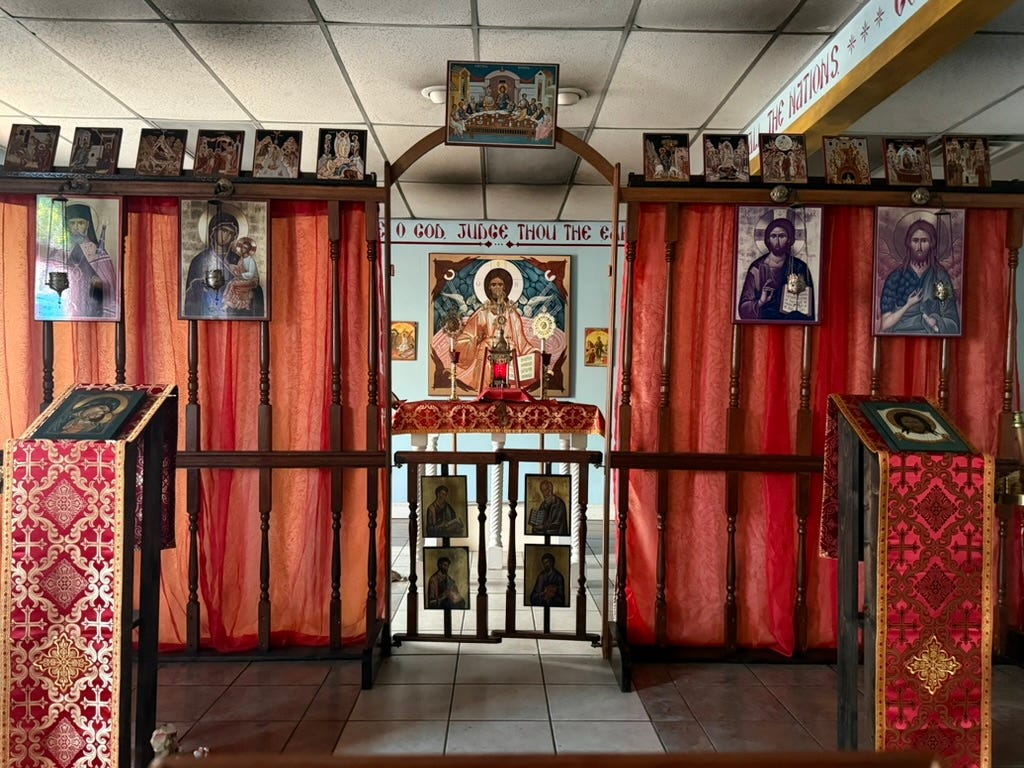
Matins is a category of service known as an “Office.” Offices are common prayers that can be prayed without a priest, if one is not available or one wants to serve at home. Other Offices include: Vespers, Compline, Akathists, Supplicatory Canons, and the Hours.
Just like any other service in the Church, Matins has various themes. One theme is that of the fall of mankind. We join Adam in his weakness. As Fr. Alexander Schmemman describes it in For the Life of the World;
When we first wake up, the initial sensation is always that of illumination; we are at our weakest, as our most helpless. It is like a man’s first real experience of life in all its absurdity and solitude, at first kept from him by family warmth. We discover every morning in the amorphous darkness the inertia of life.
And while Matins – and especially the Six Psalms – does call us to experience this darkness, it does not leave us there. This brings us to the second theme. To continue with Fr. Alexander’s meditation;
[T]he first theme of Matins is … the coming of light into darkness. It begins not like Vespers with the creation, but with the Fall. Yes in this very helplessness and despair, there is a hidden expectation, a thirst and hunger. And within this scene the Church declares her joy, not only against the grain of natural life, but fulfilling it. The Church announces every morning that God is the Lord, and she begins to organize life around God. [During Matins] the sun itself rises, dispelling the darkness of the world, and in this the Church sees the rising of the true Light of the world, the Son of God.
Along with this theme of “the Fall”, we also remember that Light has dawned in the world through Jesus Christ. The Matins service guides the believer from the Fall to Illumination.
The Matins service is an amalgamation of several services: the Royal Office, the Nocturnal Office (Six Psalms through the Kathisma), the Cathedral Vigil (from the Poleyeleos through “Having Beheld the Resurrection of Christ”), and the Morning Office (from Psalm 50 through to the end).
Because of its flexibility, Matins serves as the basis for the Funeral service, the memorial Panakhida, and various Molebans (prayer services for specific purposes). When done in its entire monastic form, it takes several hours. The version we use takes about an hour.
The Royal Office
The first part is the “Royal Beginning”, so-called because the psalms that can be chanted (19 and 20) speak of the “king of kings,” tropars in honor of the emperor (“O Lord, save your people”), and litanies for the civil authorities. The Royal Office section is often omitted in parish usage. The Antiochians do a version without the Psalms. I encourage you to sing along to “O Lord Save Thy people…” this is one of our greatest liturgical anthems; our “fight song,” if you will.
The Six Psalms
About the Six Psalms, Fr. John Whiteford writes;
The faithful should be aware of the fact that the reading of the “Six Psalms” is one of the most important points in the service ‚ a time when all should put aside other thoughts‚ stand quietly‚ and concentrate on these penitential prayers. The reading does not constitute a pause in Divine Services‚ a time during which to go for a walk outside or to talk to one’s neighbor. It is one of the holiest moments in the entire service.
During this time the lights are turned off – and the lampadas remain unlit - so that we can better contemplate our mortality and the futility of a life lived separate from God. Some believers close their eyes so that they are not distracted as they “keep their mind in hell and despair not” (St. Silouan the Athonite). Tears of repentance – metaphorical or real - are entirely appropriate during this time. I encourage you to stay as still as a corpse – not even crossing yourself – as you join the Psalmist in contemplating death and looking forward to the Resurrection. This is not a time to light candles or venerate icons, even if you first come into the nave at this time. In such cases, it is best to stand at the back of the nave and contemplate death – and hope for the resurrection - with the rest of us.
After this, in a full service, the Psalms and hymns of the Kathisma would then be sung.
---
Resurrectional Evlogitaria
The Six Psalms are followed by the Great Litany, the antiphonal hymn “God is the Lord”, the main hymns for the day, the Kathisma (we only do the hymns, to the Psalms), and the Resurrectional Evlogiteria. These hymns celebrate, among other things, the witness of the Myrrbearing Women. These hymns are separated by Psalm verse 118:12, reminding us that following God’s statutes allows us to participate in the resurrection. It is good to venerate icons and light candles during this time and all the way up to the reading of the Gospel.
The Hymns of Ascent.
These songs are related to the Psalms of Ascent (119-134; in parish usage, we sing these in their entirety at Presanctified). These are the Psalms that were sung on the way up to the Temple in Jerusalem. Symbolically, we ascend in them towards the pinnacle of the Matins service: the proclamation of the Resurrection Gospel and the Hymn of Resurrection.
The Proclamation of the Gospel
The Gospel is preceded by two prokimens (pieces of Psalm) that we chant antiphonally. The first rotates with the eight week cycle of the Octoechos while the second “Let everything that has breath praise the Lord” is the same every Sunday. In our tradition, the Resurrection Gospel is proclaimed from the south side of the altar towards the north, proclaiming Christ’s victory over the forces of evil (which sacred geography has residing to the North). The Gospel reading is followed by the last part of the Cathedral Vigil portion of Matins, the hymn “Having beheld the Resurrection of Christ.” During this hymn the priest brings the Gospel book out for people to venerate. This celebrates Christ being in our midst, with the Gospel representing His presence. Marking this, the usual greeting between the priest and the person venerating the Gospel is “Christ is in our midst; He is and always shall be.” It is fine to venerate icons and light candles from the end of the Gospel through the Great Doxology.
The Hymns of Repentance and Psalm 50 through the Canon.
The Morning Office proper begins now with the Hymns of Repentance, Psalm 50, the Deacon’s prayer, and the Canon. In its present form, each of the nine sections of the Canon begins with an Ode that is designed to connect specific Old Testament themes to the New Testament. Two notable things that happen are the singing of the Resurrection Kondak after the Sixth Ode (omitted in current Antiochian practice) and the Magnificat, sung before the Ninth Ode. It is accompanied by a full censing by the deacon.
The Praises (Psalms 148-150) and Doxology
The structure of this section is very similar to “Lord I Call” and the “Aposticha” at vespers, with the first few verses being sung in the tone of the week, the bulk of the Psalms plain-chanted (or intoned in the tone), and then the final few verses chanted in alternation with hymns that are sung in the tone of the week. In our parish, on Sundays, the “both now and ever” verses for the Theotokos are always the same words sung in tone two (Obikhod).
After the Praises come the Great Doxology.
Fr. Dimitri Sokolof
After the Psalms of Praise with their hymns have been chanted, the Holy Doors are opened and the priest calls out “Glory to You Who has shown us the Light,” thus inviting the faithful to glorify God for having given us the Light of the spirit – Christ Savior, who came into the world to illumine mankind, which had theretofore lived in the darkness of superstitions and iniquities.
During the Great Doxology, the Deacon performs the Great Censing of the Proskemedia, the altar, and the entire nave, purifying us and the worship space one last time before the Divine Liturgy begins. At the end of the Doxology, a hymn of the Resurrection is sung.
Bibliography
Neale, J. M., & Littledale, R. F. (1874). A Commentary on the Psalms from Primitive and Mediæval Writers: Psalm 119 to Psalm 150. (Vol. 4, pp. 357–358). London: Joseph Masters.
Reardon, P. H. (2000). Christ in the Psalms. Chesterton, IN: Ancient Faith Publishing.
Sokolof, D. Archpriest. (1968) A Manual of the Orthodox Church’s Divine Services. Jordanville, NY: Holy Trinity.