

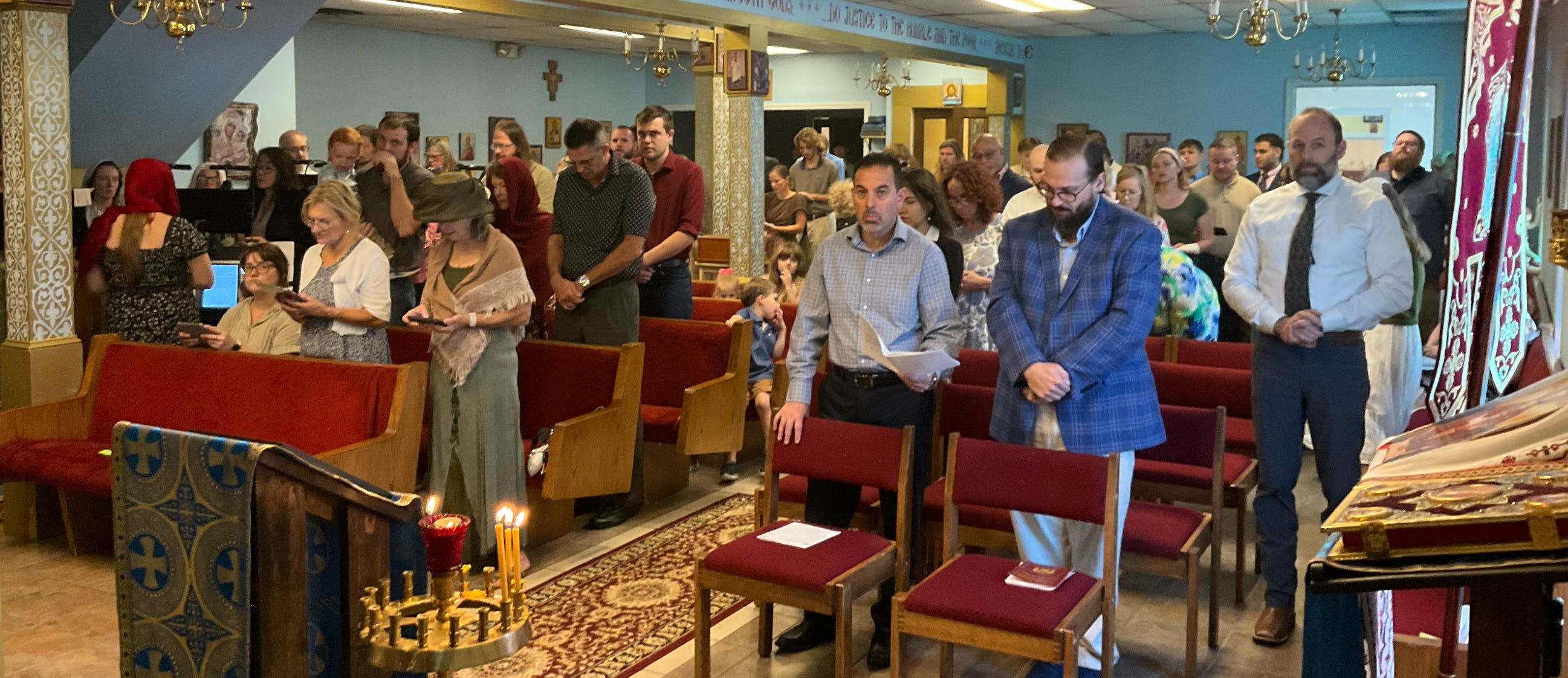
Before the “Blessed is the Kingdom”
Let all things be done decently and in order. (1 Corinthians 14:40)
St. Paul was dealing with a dangerous situation in Corinth: factions, a lack of self-control, and a lack of humble charity; all leading to a lack of fellowship. Individual vices compounded, threatening to turn the liturgy into a parody of its purpose: a diabolical ritual of division rather than a godly one of communion. Proper order in church is essential for cultivating the kind of loving environment that will open the community to the presence and working of the Lord in their midst.
But the answer is less the imposition of rules than it is a restoration of real purpose and meaning. This is a hospital; and we are both patients and healers. There is an important thing that good doctors know but that many have forgotten. It’s not just about identifying ailments and their corresponding prescriptions. That’s important, but we can’t forget the context in which medicines work: the body wants to be well. A healthy atmosphere isn’t just one that is free of disease, but one in which people flourish. Orthodoxy, with all of its rituals and all its beauty, and the availability of grace, is designed to facilitate that kind of atmosphere. Everyone who comes to church has given their lives to Christ; they want to be made well and know that the Christ who is in their midst is the one who can make it so.
So how do we make sure that everything is done decently and in order; that is to say, in a way that builds piety, community, and love? Again, the body wants to be made well; it is designed for health. I’m not just talking about the individual bodies, but the collective body of believers. It wants to be well, with the eye doing its part and the foot its own, with all of the members being under the governing authority of the head. And that head is not – of course - any of us, but Christ. The liturgical dance perfects us when we defer to and follow His lead; and he leads with harmony, beauty, and truth. The rituals of the Liturgy, crossing ourselves, bowing, the processions, the queuing and folding our arms before communion, the constant movement of the children, the singing together, the speaking in unison; all of it molds us from broken individuals, through grace, into a holy family; His holy family.
Every year, I vary the theme of the teaching liturgy. Today, I am going to focus on some of the rituals that help us develop the kind of culture that will lead us always onward and upward.
After the First Antiphon
The rituals are awesome, but how do we know what to do when? Two things will help: first, finding people who have been doing this for a while and doing what they do. That’s the traditional way to learn; not from books, not from the YouTubes, but by being part of a real community and imitating the people who have been doing things well for long enough for it to become natural. The second is to realize that there is often more than one way that experienced people do things, and therefore, that there is more than one way to do things well. This does not mean that “anything goes.” But, at least in this parish, it means that doing things “decently and in order” doesn’t mean that everyone’s actions are perfectly choreographed and everyone moves in lockstep. There are many biblical verses and images that support this view, from “let the little children come unto me” to “the strong bear the burdens of the weak” to the constant movement of the the cherubim and seraphim around the very throne of God tto the image of the church as parts of a body all with different functions and roles; all speak to harmony within a unity of vision rather than uniformity of action.
After the Second Antiphon
An example of a harmony resulting from unity of vision leading to different actions at any given time is the ritual of venerating icons and lighting candles. In general, this is a time for communal prayer; this is why it isn’t really appropriate to say the Jesus Prayer during the services: it is a private devotion, in part meant to deepen our participation in the greater mysteries. Venerating icons and lighting candles are private devotions and venerating icons are private devotions, but they are part of the ritual of preparation for entering into communal worship. They are the traditional things that Orthodox Christians do when they first arrive to the service. For a very few people on Sunday morning, this is done before the start of Orthros. For everyone else, it is done when they first arrive. Just as it is proper when arriving to a big celebration at someone’s house to seek them out and greet them when first arriving, so it is proper to go and venerate the icons of Christ, His Mother, and St. Raphael when we first arrive. I also go over and venerate the Gospel at the place where we do our confessions to ask the Lord for forgiveness of sins, and the icon of the Inexaustable Cup to pray for people who are struggling with addiction. It is also traditional at this time to light candles and pray for our families, our friends, those who are struggling, and, in the Memorial place, for our departed loved ones.
After the Third Antiphon
A minute ago, I told you that it is traditional to go to the front and venerate the icons when you first come in, no matter when that is. This is one of those examples of how people can do things at different times and all be right. But, again, that does not mean that “anything goes.” For one, we don’t play with candles, and we should always light candles with our children to reinforce the proper – and safe – way to do it. In addition, there are times when it is not appropriate to venerate icons and light candles: we do not do that during the processions of the Little and Great Entrances; during the reading of the Epistle and Gospel, and during the Homily. You may feel self-conscious coming up front to venerate icons even when it is allowed, but I assure you that it is part of the constant movement of the “liturgical dance” in established parishes in traditional Orthodox nations. At the very least, venerate the icon of St. Raphael when you first come into the narthex, the icon of Christ there in the middle of the nave when you come in here, and, if you are short enough, the icon of the angels, as well.
Homily
We are the hordes that were brought out of the hedges and byways. We were dirty and broken; but the Lord invited us into His house. Into His Kingdom. Our clothes were soiled and torn; how could they not be? But the Lord didn’t want that to divide us or keep us from the celebration, so He gave us wedding garments. Again that is us. But it’s not really about clothes is it? Yes, we should wear clothes that are appropriate – modest, humble, and respectful, but the clothes are really about the state of our soul. At baptism, God gave us a new garment by forgiving us of our sins. He clothed us in the robes of righteousness. The language of the baptismal services says that we are meant to keep it “undefiled.” This isn’t about clothes. It’s about virtue. I can wear these vestments, and still be like a whitewashed sepulcher on the inside. This makes me like the man in the parable who was sent into eternal torment, despite the fact that my vestments are so nice. For what it is worth; one of the reasons that we vest our priests in such beautiful vestments is so that you are not distracted by my sin. It is similar with the way we dress; when we dress modestly, we do not distract people by our pride. And, the beautiful thing about rituals is that, done well, they transform our hearts. The longer we dress modestly and piously, the more that the acts of putting on and wearing those clothes transform us into modest and pious people. This is not a case of faking it until we make it, but rather “dressing” as the people we are striving to become more of. I have dressed like a priest long enough to have seen the transformation in myself.
The Release of the Catechumen
Starting next week, we will be releasing the catechumens (“Depart all catechumens, let all catechumens depart…”) to go upstairs for instruction on the Orthodox Christian faith.
Before the Great Entrance
It’s okay to move around during the liturgy: in fact the people on the sides and in the middle will need to move out of the way in this next section so that the clergy can process for the Great Entrance. In addition, some people may want to make their way to the procession to touch the vestment of the deacon and priest. This is a good and pious ritual as long as it is done reverently and with the proper understanding. When we do this, we are imitating the woman with the issue of blood who touched Christ’s garment and received healing. But it’s important to remember that in the symbolism of the Great Entrance, Christ is being carried into Jerusalem on a donkey. I, your priest, am just the donkey; Christ is symbolized during the movement by the bread I am carrying. You don’t touch it or the garments that cover them because that would not be safe; so, instead, you touch my garment.
After the Litany of Supplication
God wants us to be one as He is One. The skills of community have atrophied quite a bit; the Liturgy will help to build them back up. One of the ways we do that is by singing together and saying things in unison. Doing this well requires that we submit ourselves to the rhythms, melodies, and patterns of the things that are being sung and said. We add strength to the celebration in the same way a single twig adds to the strength of a bundle; not by standing out, but by being part of it. When one of my seminary students asked a monk for advice on how best to sing as part of a church choir, he told her to be invisible. What he meant was that our rhythms and pitches should match that of the music and other singers in a way that adds to the whole rather than distracting from it. This is as true when we are reading the communion and post-communion prayers as it is when we sing the Our Father, the Creed, and Lord have mercy.
Before the Kiss of Peace
We are going to try something today; it’s new to many of us, but it is actually something quite ancient. After the exclamation, “Let us one another, that with one accord we may confess…” we are going to share the kiss of peace.
During this time, you may turn to the people immediately around you to quietly share the greeting “Christ is in our midst… He is and shall be.” If there is room and the other person is up for it, you can also share a dry kiss on each cheek. Please don’t move around for this; this is one of those things where there really can be too much of a good thing. Regardless, it is best to be finished with your greeting when the deacon or priest comes out of the altar and offers that same greeting, “Christ is in our midst,” to you; that puts a punctuation mark on the kiss of peace and is the indicator that it is time to stop the greetings so that we can say or sing The Creed together. The reason most parishes do not do this good and ancient practice is that it can become immoderate and disruptive. Let’s avoid that.
Before the Anaphora
This is the pinnacle of the service. All of our attention is on participating in the prayers and beauty of the changing of the Gifts and our own partaking of them. Please not that, while it is never proper to talk during the Divine Liturgy, it is especially important to stay quiet during the Anaphora and Communion. Seriously, we shouldn’t even be talking in the Fellowship Hall while people are taking communion.
Final Word
Everything needs to be done in good order, but this is the good order of an orchestra or a ballroom dance rather than that of a military parade.
Recognizing the need for order, we are sometimes tempted to impose discipline on others without first cleaning up our own thoughts and actions; maybe even using the log in our own eye to beat people about the head to get them to fix the spot in theirs. That’s not required. Everyone is trying to do things well. Plus, this isn’t basic training; it’s a hospital. Hospitals have their own rhythms and their own disciplines, but it is a quiet, persistent, and patient one; devoted not to order for its own sake, but for the sake of healing. People want to be well; let’s let all we do here be done in love so that health and holiness may abound.