

Before the “Blessed is the Kingdom”
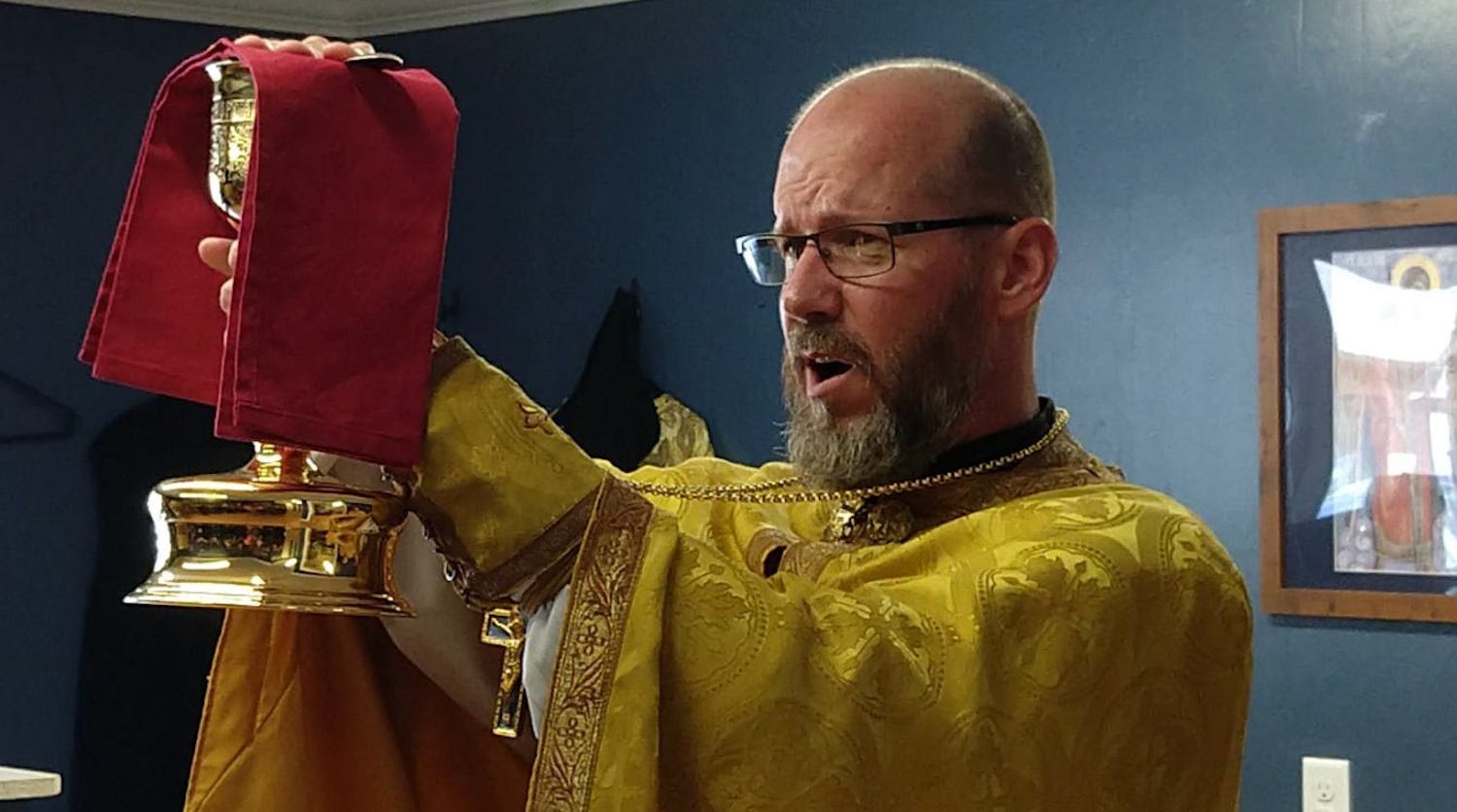
Christ is in our midst!
Today it is a great blessing, as always, to gather together in the praise, worship, and supplication of the Lord. Today we’re going to do what’s called a teaching liturgy. At different parts during the Liturgy, we’re going to pause, and I’m going to offer a reflection on it.
I love doing this, in large part because I love the Liturgy so much, and not apart from my love of Christ. The Liturgy, for me, is one of the ways that I find the purest expression of that love and the purest way for me to feel His love for all of us.
We’ll do this, Lord willing, every year, and there won’t be much repetition because there is always so much. This is one of the great mysteries: because God is beyond time and beyond space, it is possible to continually grow in His love and in knowledge of Him, and to work toward His glory without ever reaching the end of it. Through Jesus Christ, this is possible. It is a wonderful thing to gather together in that reality.
So what is this Divine Liturgy? Today you’re going to get more of a mystical reflection than a historical one.
Before we begin, I want you to think of a time when you knew love, when you felt peace—not as an external thing around you, but as something that had moved into your heart. Think of a time when you had, at least for that moment, no doubt that love was real, that you were in that love, and that that love was moving you deeper into something glorious.
Or perhaps I’m overstating it. Think of a time when you felt free to be yourself.
For many of us, when we think of those memories, it’s a place and a time when we were safe, when we were able to be vulnerable without risk, when we were outside, perhaps, our normal routines. It gave us a chance to open ourselves to something that, as Christians, we know to be reality: God is continually with us, offering us His mercy, His love, His comfort, and His strength.
So often we are not open to that experience. So often, because of all our baggage, the shields that we have built up, all the walls and armor, we aren’t able to experience that.
But this is what we are meant to work toward: developing our hearts so that they are continually open to that reality; creating within our homes the kinds of cultures where we are safe and can be open to that experience; and certainly, within our churches and parishes, that is what we are doing here. That is what it means to live as a people of God: a people who are continually open not just to the knowledge of God, but to the experience of Him.
Without opening our hearts to Him, He cannot live within us and we within Him, as Saint Paul says we are called to do.
So the Divine Liturgy is set up—it is designed—with this in mind. The Lord knows our armor. He knows the things that keep us from being open to an experience with Him. This is one of the ways—I would say it is the main way—that He has established for us to be in Him and Him in us.
Do we do it through prayer? Yes, of course we do. Do we do it when we’re with our friends and with our families? Yes, of course. But this is a way that is always available to us.
So that’s what we’re going to reflect on. We’re going to reflect on the way this Liturgy opens our hearts to an experience of God, so that we can be in His grace, be forgiven of our sins, and have a new life in Him, growing toward perfection in glory with Him forever.
At the end of the Liturgy, afterward, when we’re sitting around, I encourage you to ask questions. Ask, “Why this thing? How does that fit in?” I love those kinds of questions.
When I was considering becoming Orthodox, I wasn’t going to commit to anything until I was convinced that this was a system I could trust, because I knew the Lord Jesus Christ, and I knew that I wanted to have a life in Him. I wanted to see how the Orthodox experienced that.
I was convinced enough not just to become a member—remember the old commercials, right?—but also a priest.
So let us begin our worship with Him. Again, I’ll offer reflections. It may seem to break up the Liturgy a little bit. That’s why we don’t do it every time. Usually, there’s only one part where the priest adds to the Liturgy, and that’s during the homily. But even there, the homily is taken at different times in different traditions. We’re used to it being after the Gospel, but I’ve known priests who did it at the end, and some priests after they took Communion. So think of it kind of like that.
After the First Antiphon – on transitioning into grace
Thinking again of those times when we feel at peace, when we’re open to God’s love, usually it’s not something like the road to Damascus experience, where we’re doing one thing and all of a sudden—boom—it hits us. Oftentimes, it takes a time of transition.
For some of us, we like to go into nature, and it takes that time of getting into the woods and maybe spending about an hour walking until the confusion of the world finally leaves our thoughts and we’re able to be open to God and to how He appears and reveals Himself to us in nature.
It’s the same for us as we come into the church. We can’t expect ourselves simply to flip a switch: “Okay, I’m worried about traffic. I’m worried about how much gas my car has,” all those things that the world throws at us, “but now, when I walk through the doors—boom—I’m ready to know God.”
We need a time of transition, and the Liturgy has that built into it. I don’t want to say that these words are wasted or anything like that. That’s not what I’m saying. But if we went straight from “Blessed is the Kingdom” to the proclamation of the Gospel, the reading of the Gospel, and the preaching of the Word, we wouldn’t be as ready to hear it and to experience and interact with it in peace.
So what we do is sing these songs that are of God, that are about God, and they’re beautiful. The poetry of the words and, glory to God, the beauty of the music lift us up and prepare us during this service.
The Kingdom of Heaven and our world are united in one. This is the realization. This is why, in many of our churches, they’re built with a dome. It’s God coming down in our midst, and there is created a place outside time, outside space, so that we can be in that experience.
But we can’t just walk into it and say, “Okay, I’m here, God. Talk to me.”
So this is one of the reasons why, during this Liturgy of the Word, we have this preparation: to prepare our minds and our hearts to be open to the proclamation of the Gospel.
After the Second Antiphon – on the silent prayers
Now we’re going to have another litany. Our prayers are repeated. We sometimes say the same prayer several times. Why is that? Well, because we’re supposed to. The Gospel tells us: if this is important, ask the Lord for it, and ask again. Don’t give up on your prayer. Keep asking. That, by itself, will soften our hearts so that we can actually be prepared for the answer and the response of God in His love.
If you’ve been to a Liturgy before, you may have heard some extra words, unless you go to an Antiochian parish. The doxology at the end of the litany is not usually taken out loud in our tradition, just the last part. But those are the endings of a prayer that has been offered on behalf of the people of God. They’re sometimes called the silent prayers.
There’s even music designed to give the priest time to offer those prayers in earnest on behalf of the people.
People can get wrapped around the axle about whether these prayers should be taken out loud or not. Obviously, I don’t get wrapped around that particular axle. I serve an Antiochian church when I’m not here. I say them out loud every time. It’s not a problem.
It’s only a problem if we think that those prayers are only for the priest. How could that possibly be just for the priest, unless it’s a prayer asking for him, asking for forgiveness? These are offered by the priest on behalf of all the people.
This points to one of the interesting things about the structure of the Church: there are different roles. Notice I went sideways [with my hands], right? I didn’t go up.
This [up and down] is sometimes the model that we get, and Saint Dionysius was trying to teach us certain things about the heavenly and the earthly kingdom. He made it seem to suggest that priests were above the people and bishops above the priests. But in the Kingdom of God, it’s not like that.
There’s the royal priesthood, and within that royal priesthood, all of us are called to a life in Christ, a life in holiness, with different roles.
So you figure out: What is the role that I’m called to fulfill? In most of our life, it’s messy. But I know when I walk in here, “Today I’m the priest.” So I put this on, and then I pray as a priest.
It doesn’t mean that I’m praying prayers that are better than the prayers that you did or anything like that. It’s the role. It’s like within a family: there are roles that each person has, not so that one can lord it over the other. No, not at all. It is so that the Kingdom can be made manifest within that home, so that the Kingdom can be made manifest here.
Not with me playing some kind of god, but leading us as the people of God in prayer toward the Lord. It’s an important distinction.
These prayers are not secret in the sense that we keep them hidden from you. They’re available in every Liturgy book. You’re allowed to read them. Every once in a while, we’ll take them out loud because the theology of the prayers of the Church is pure, and we learn how to pray from them.
After the Little Entrance
So this is an interesting ritual that we just did. I took the Gospel Book up from the altar, brought it around, and now I’m going to put it right back in the exact same place. This is called the Little Entrance.
You’re allowed to ask questions: Why are you doing that? How did that end up there?
Well, it ended up in the Liturgy for different reasons, but it represents—it’s symbolic of—Christ coming into the midst of His people, incarnate two thousand years ago.
In some traditions, the Gospel will be held in front of the people and it will be proclaimed, “Christ is in our midst,” as a reminder: yes, two thousand years ago these words were spoken and lived by the incarnate God in our midst, and He continues to be in the midst of all of His people.
This is a glorious proclamation. As Christians, we know this. This is beginning Christianity. But when we participate in it through ritual, we are psychosomatic beings. The physicality of the faith reminds us of the truth of it.
This is why we have these different rituals. It’s not just because it ended up in the Liturgy because the Gospel used to be hidden or something like that. This is very intentional.
We’re remembering the time when Christ was literally in our midst, proclaiming the Gospel, preparing His people for His death and resurrection. And now He is in our midst so that we can participate in that death and resurrection, a new life in God through Christ.
The Time of the Homily – On the Glory of God
In the name of the Father and the Son and the Holy Spirit. Amen.
Christ is in our midst.
So this would be the time when the priest would usually give the homily. Instead, I’m going to share a little bit more about the service and why it is we do it the way we do.
One of the most striking things to people from other Christian traditions is our use of incense. We use incense in the Church, and yes, it smells nice and it’s good. There are a lot of hypotheses about where this comes from, whether it comes from pagans or whether it comes from Constantine or something like that.
Well, in the Orthodox Church, there is an intentionality to reflect the glory of God, the throne room of God. In the Bible, we’re given glimpses of this, both in the Old Testament and in Revelation. Wherever God is, He is surrounded by beauty. He is surrounded, oftentimes, by smoke, incense, sweet-smelling fragrance, fire, and so on.
And so it is not just the incense, but the structure of the church itself.
There are different ways to try to provide an encounter with the difficult mystery of the Incarnation: God and man. You can move toward the man part and look at Him in His humility, or you can look at Him and say, “No, we need a reminder. We live in our humility. We know what a man is like. We do not know what the glory of God is like.”
That is the path the Orthodox Church usually takes in its architecture and its focus on beauty.
It’s not to puff ourselves up. It had better not be to puff ourselves up and say, “Look what we have built! Look what we have here!” That would be wrong. That would be the worship of a false god.
Instead, it is done to the glory of God so that we have a sense, the beginning of an understanding, of what He is in His glory.
The prayers that I read before the Little Entrance, when I brought the Gospel out, mention how the Lord is always surrounded by His glory: Cherubim and Seraphim, these holy beings continually singing His praise.
We don’t really have a sense of what glory is in our world. We have a sense of what popularity is, of what riches provide, and things like this, but not the glory of holiness, purity, and truth.
And so the Orthodox Church is set up in a way to give us the beginning of an understanding so that, through participation in worship in such structures, surrounded by that kind of beauty, our minds and our hearts can be open to the reality of the true beauty that is in God.
That is also, by the way, why we sing everything. We sing everything.
This is another notable difference. [People ask;] “Why do you sing? You chant the Gospel. It would be much easier to understand if the priest just read it.”
Okay, fair enough, especially sometimes when we ornament it too much.
But so far, I’ve described the Liturgy as if it were a way of establishing our individual hearts, preparing them for an encounter with God. It softens our hearts, opens them, so that we can know Him and be ready for His love, His mercy, His strength, His courage.
But when we add the music to it, it helps us realize that we are not being brought into salvation alone. The Lord desires that we be one as He is one.
And so it is that the pinnacle of our experience of God on this side is done communally. More than just communally, it’s done through music.
Think about what music does to us. It forces us to be together. Music, in order to be done well, requires that you listen as much as you sing. You listen so much that your reality merges with the reality of the singer next to you, so that you are ready to match and harmonize with him and move together as a group in beauty to the glory of God.
Again, it can seem like maybe it’s just a ritual, maybe just a drug. But when it is filled with the knowledge of God and with the beauty of His Word, as it is here in the Liturgy, it moves us to something greater.
It allows us to participate in the oneness that God desires for us: us in Him, Him in us, and us together as He is one.
Music allows us to do this in a very special way.
The call and response from the priest to the pleros, with the “Lord, have mercies” and so on, is very intentional. They overlap. They share the same pitches. They harmonize together.
This is the way that we are meant to live together: listening to one another, not just so that we can respond to them, but so that we can know them, so that we can share their lives and live in harmony together.
This is not something that comes naturally to us in our human state. We need to have these patterns of behavior, which can be experienced through music, in order to get us out of the rut of the sin that has rooted itself in us, the loneliness, the individuality that makes us separate ourselves not just from God but from other men.
The Liturgy is part of the cure for that illness through our Lord Jesus Christ.
We’re now going to continue with the Divine Liturgy. We’re going to make a transition from the Liturgy of the Word to the Liturgy of the Sacrament of the Eucharist.
After the Litany of the Catechumens
The fact that the Lord chose to present Himself—His Body, His self, His reality—to us in the form of a meal again teaches us something about how we are not meant to be saved alone.
The table is a communal place. It is a place where family and friends, people united in fellowship, gather together.
This is the best Thanksgiving dinner, lifted up to a new level, because our Lord Jesus Christ was there in the flesh, offering Himself to us: “This is My Body. This is My Blood. Do this in remembrance of Me.”
“… Participate in this until all things are remade.”
It can seem a little strange. We need to be reminded that it is a meal that we are celebrating, because sometimes we forget that this is a table. It’s an altar, yes, but it is a table.
The cup and the plate will be placed here. We don’t all gather around; there’s not room. It’s brought out to the people.
But you should recognize that it is the fulfillment of the very best meals that we have together with our families, with our friends, with our Lord Jesus Christ.
Let’s continue into that part of this service.
Priestly (Silent?) Prayer for the Faithful
Again and again, we bow down before You, our good and loving God, and we pray to You. Hear our prayer. Cleanse our souls and bodies from every defilement of flesh and spirit, and enable us to stand before Your holy altar free of guilt and judgment. Grant also, O God, to those who pray with us progress in life, faith, and spiritual understanding, so that they may always worship You with fear and love, and may partake of Your holy mysteries without blame or condemnation, and be made worthy of Your heavenly Kingdom, so that, ever guarded by Your might, we may give glory to You: to the Father and to the Son and to the Holy Spirit, now and ever and to the ages of ages.
Before the Great Entrance
So this next moment is the Great Entrance.
Before, we brought the Gospel out for the Little Entrance. For the Great Entrance, there’s the movement of the gifts that have been prepared before this service from the side altar to the central altar, to the table.
There’s an interesting allegorical meaning here. Just as when we brought the Gospel out, it’s a ritual reminder of Christ in our midst.
During this time, we are reminded of a couple of things. One is the movement of our Lord amidst His people during the Great Entrance into Jerusalem on Palm Sunday—or Willow Sunday.
So it begins as this triumphal thing: Christ in our midst, and He’s held up, and the priest is saying these prayers. It’s a joyous thing.
The Lord has finally come into His place.
But then, as the priest takes those gifts up into the altar—and often there are stairs—we participate in that transition, that time of recognition that there is something difficult that comes between that moment and the glorious Resurrection.
That is the Lord sacrificing Himself for us, for our salvation, through the remission of our sins.
As those gifts are placed on the altar, the prayers that the priest says are remembrances of that: “The noble Joseph took down Your most pure Body from the tree, wrapped it in clean linen and spices, and laid it in a new tomb.”
Then the covering is no longer the covering, the swaddling clothes of the infant. It becomes the shroud of the tomb, the wrappings around our Lord in His grave.
But we know that this is not the end. We live on the other side of the Resurrection. We live in that time when the Lord has been resurrected, and we are living a new life in Him.
And so we prepare ourselves for an encounter with Him through His Body and Blood.
Before the Anaphora
I just want to call attention to one thing. We are about to go into the most solemn part of the service and there is no way that I would interupt it to offer a reflection; the best reflection would be hesychastic [silent], so after these remarks, I won’t offer any more comments until the end.
One of the nice things about our mission setup is that – while we love our iconostases – it’s natural here for you to be able to see and be a part of what is going on on the altar in a way it isn’t in many Orthodox Churches.
Before the service, the priest commemorates the members of the community and the people whose names have been brought to him for prayer. All of those are represented by a piece of bread and put onto the plate, next to the piece of bread that becomes the Host.
So it’s a symbol of us there.
And then the beautiful thing is, at the end of the service, we consume the Host together, and there remains the Body and Blood, especially the Blood in the cup.
All of those commemorations, all those names, are put into the cup with the prayer, “Lord, wash away the sins of those commemorated here by Your precious Blood, through the prayers of Your saints.”
It’s a wonderful reminder of the universality of salvation: that through the Blood of Jesus, through His Passion on the Cross and through His Resurrection, all are saved through His Blood. All who have given their lives to Him are saved through His Blood.
It’s a great mystery, and it’s a wonderful reminder that even when we are apart, we are still together in Christ and, in this case, literally in His Blood.
It’s just a beautiful thing.
So if you ever do have someone that you’re praying for, bring those prayers so that we can pray together for that person, for that concern, together as well. We struggle together.
At the End of the Service
I just want to point this out [pointing into the altar]. This is an antimension, and this is the thing that is given to the priest and the parish. It is permission for us to serve the sacred services here together around this table.
This one is a replica of one from sixteenth-century Ukraine.
Without it, the priest—even a validly ordained priest—is not allowed to celebrate the Liturgy.
What this is a reminder of is that we are not alone in our salvation. We are part of a Church, a Church where there are roles, and the priest and the people need the blessing of a bishop in order to celebrate divine services.
This is the symbol and the actuality of the blessing of a bishop, so that we’re allowed to celebrate together.
What a blessing to celebrate our Lord Jesus Christ and His love for us together.
Please come forward to venerate the Cross and receive some of the blessed bread.