

This summary and transcript were excerpted and edited, with permission, from a Teaching Divine Liturgy on the “Coffee with Sister Vassa” YouTube channel. During this video, the priest, Fr. John Klingel pauses the service at certain points so that Sister Vassa can share her reflections on that portion of the Liturgy. Sister Vassa also has an excellent lecture series on the Divine Liturgy. All mistakes in transcribing, summarizing, and editing her material are my own (Fr. Anthony Perkins). I benefit greatly from teaching Liturgies and offer this to help other priests develop their own versions, should that be appropriate.
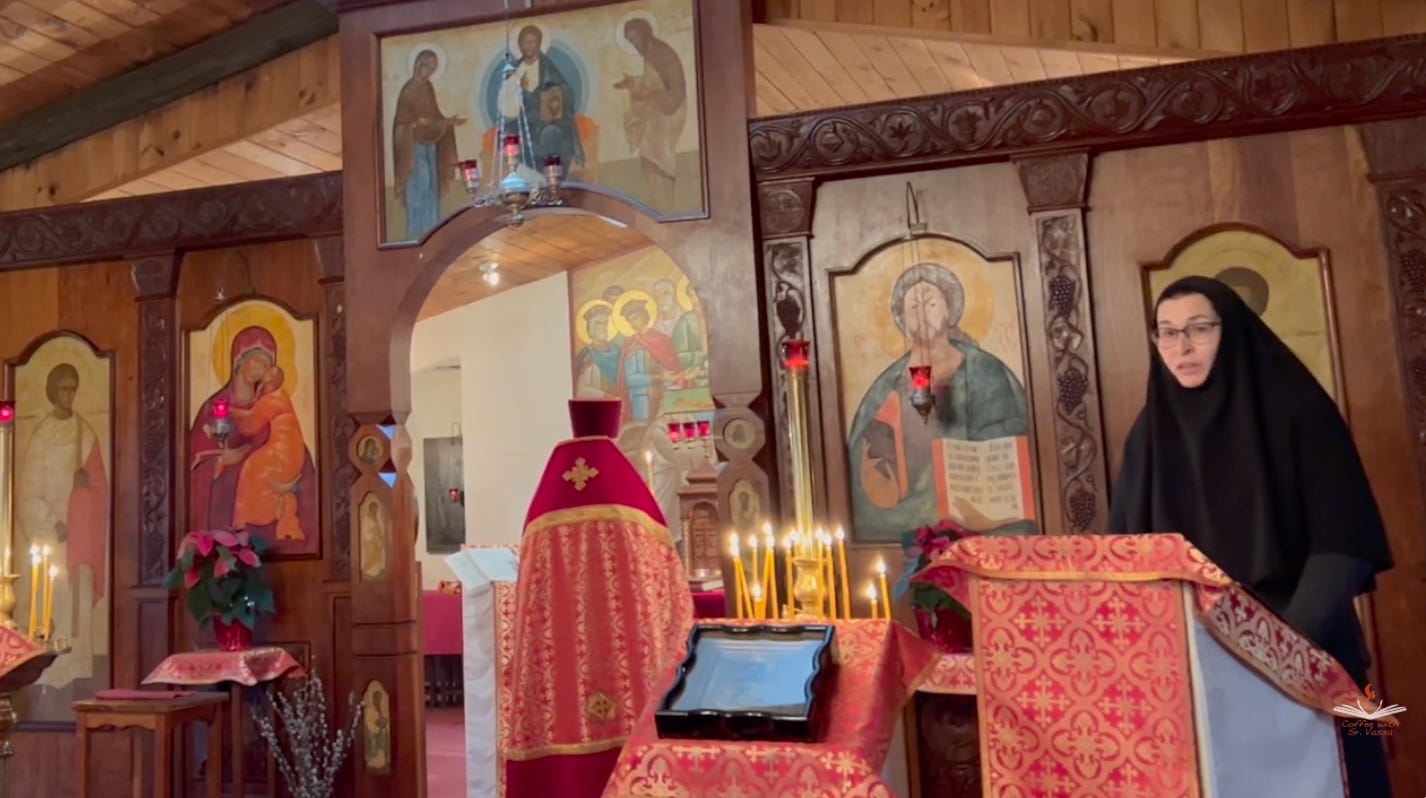
SUMMARY VERSION
The Gathering and “Blessed is the Kingdom”
When we first come together for the Divine Liturgy, we carry with us the noise, burdens, and distractions of daily life. The Church, in her wisdom, does not demand that we shed these instantly; instead, the opening moments of the Liturgy are like a gentle transition, a spiritual “warm-up.” We gather around the celebrant, but we also gather around Christ Himself, the invisible High Priest, who offers Himself — and invites us to offer ourselves in return.
This self-offering begins with our first act of dialogue. The priest proclaims: “Blessed is the Kingdom of the Father and of the Son and of the Holy Spirit.” These are not words to be overheard; they are words that require our response. We are not passive spectators. The Kingdom is proclaimed, and we affirm it by saying Amen. With that single word, we declare, “Yes, this is true. Yes, this is the authority I recognize. Yes, I step into this holy reality.”
In this way, the Liturgy teaches us to let go. We begin releasing the things that divide us, distract us, or weigh us down. The prayers and litanies that follow — “In peace, let us pray to the Lord” — call us to embrace peace instead of resentment, unity instead of division. Slowly, we are led out of our baggage and into freedom. The Liturgy is not just God’s work for us; it is also our work together — leitourgia, the work of the people, for the people.
The Little Entrance: The Gospel and the Beatitudes
As the Liturgy moves forward, we arrive at the Small Entrance. The priest takes the Gospel book from the altar and carries it out, only to return it again to its place. On the surface, it may seem like a simple ritual motion, but it carries profound meaning. The Gospel, resting at the center of the holy table, reminds us that the Word of God is always at the heart of our worship. When it is lifted up and brought among us, we are reminded of Christ’s own coming into the world — His advent, His ministry, and His return to the Father.
This movement is surrounded by words and hymns that prepare our hearts. The psalmody reminds us to bring all of life’s sorrows and joys before God. The hymn about Christ, the Only-Begotten Son, taken just before the Small Entrance, recalls His incarnation, death, and resurrection — the central mystery of our faith.
[And then, at least in the northern Slavic tradition, as the entrance leads us deeper into the Liturgy, we hear the Beatitudes. But notice how they are introduced: not with triumph, but with the cry of the penitent thief, “Remember me, O Lord, in Your Kingdom.”
The Beatitudes are the commandments of the New Testament, a countercultural charter of what it means to live in Christ. Blessed are the poor in spirit. Blessed are those who mourn. Blessed are the meek. These words run against the grain of worldly success, but in them, Christ gives us a new way of seeing: weakness is not defeat, meekness is not failure, and sorrow is not despair. These, too, are paths into the Kingdom.
After the Gospel: Standing Aright
When the Gospel is proclaimed, we are transported into the very scene of Scripture. Gospels, we meet a woman who had been bent over for eighteen years, unable to stand up straight. She was not possessed, but burdened with a “spirit of infirmity” — something that had crippled her body and spirit. And yet, in the synagogue, on the Sabbath day, Christ laid His hands upon her, and she was made straight.
The Gospel says she “stood aright.” The Greek word behind this phrase is connected to the root of orthodoxy — “upright praise.” To stand aright is not only a matter of posture but of worship, of being restored to the ability to lift our eyes toward God in thanksgiving. The Lord’s work is to raise us up, to free us from whatever has bent us down: grief, resentment, sin, or despair.
This healing also reminds us of the Sabbath. While human rules sought to limit what could be done, Christ reveals that the Father never ceases His work of love. God did not stop working after creation; He is always sustaining, healing, and making new. The liturgy trains us in this same posture: we sit, we bow, we rise, and above all, we learn to stand aright before Him. Even when life leaves us stooped over by pain or regret, the Eucharist touches us with grace and straightens us in thanksgiving. We are called by the deacon to “Stand Aright” several times during the Liturgy.
The Great Entrance: Offering and Becoming Icons
At the Great Entrance, bread and wine are carried in solemn procession from the table of preparation to the altar. On the surface, it seems a simple transfer of gifts, but this is a deeply symbolic act. The offering of bread and wine represents our own offering of ourselves — our lives, our struggles, our joys. These simple gifts, the fruit of the earth and the work of human hands, will become the Body and Blood of Christ. And so, in them, we place all that we are, trusting God to transform it.
As this procession unfolds, the choir chants the Cherubic Hymn: “Let us who mystically represent the cherubim, and sing the thrice-holy hymn to the life-creating Trinity, now lay aside every worldly care.” These words invite us to see ourselves as more than ordinary participants. In that moment, we are called to become icons of the angels, joining heaven itself in its unceasing praise.
But there is a condition: we must “lay aside every worldly care.” The resentments we nurse, the burdens we carry, the inner voices that accuse us — all of these must be set down. Only then can we receive the King of all, who comes to us in humility and forgiveness. Just as the risen Christ appeared to His disciples with the greeting, “Peace be with you,” so too does He meet us here, ready to reconcile us and feed us with His own life.
The Kiss of Peace and the Creed: Love and Our Common Story
Before we enter the central prayer of the Divine Liturgy, the anaphora, we are called to make peace. The priest exhorts us: “Let us love one another, that with one mind we may confess…” This is not a polite suggestion. It is the necessary condition for true worship. How can we proclaim the unity of the faith if our hearts are divided by resentment, jealousy, or bitterness? To confess with “one mind” means first to let go of what separates us, forgiving both ourselves and one another.
In ancient times, this moment included the kiss of peace — a real, physical expression of reconciliation. While many churches no longer exchange the kiss in that form, the call remains: we must let ourselves love. This means allowing God’s unconditional love to reach us, despite the “yes, but” that so often rises in our minds: Yes, but how could He love me? or Yes, but what about what they did to me? The Liturgy teaches us to drop the “yes, but” and to rest in the truth that we are loved.
Only then do we proclaim the Creed — not as a dry theological statement, but as our shared story, our sacrifice of praise. From creation to Christ’s resurrection, from the Spirit’s presence in the Church to our hope for the life of the age to come, the Creed is our collective act of remembering. To remember God’s saving works is to give thanks. And in speaking these words together, we become a people shaped not by divisions or ideologies, but by gratitude for what God has done, is doing, and will do.
The Anaphora: Mercy, Remembrance, and Thanksgiving
At the heart of the Divine Liturgy is the anaphora — the great prayer of offering. The priest calls us to stand aright, to attend, to lift up our hearts. In this moment, we are fully present before God, joining earth to heaven in one act of praise and thanksgiving. The gifts of bread and wine, fruits of the earth shaped by human hands, are offered up. But more than that, we offer ourselves, our lives, and our very being, that they too may be consecrated by grace.
The priest proclaims: “A mercy of peace, a sacrifice of praise.” God’s mercy is not simply the withholding of punishment; in the ancient sense, it is His overflowing generosity, His abundant sharing of Himself with us. To recognize this is to respond in gratitude. The whole anaphora is an act of remembrance — not mere recollection, but a making-present of God’s saving works. We remember creation, the incarnation, the cross, the resurrection, and the life of the age to come. In remembering, we give thanks, and in giving thanks, we are transformed.
Soon, the priest will invoke the Holy Spirit, calling Him down upon the gifts and upon all of us. This is no distant reenactment of the Last Supper, but the living presence of Christ among His people. Here we taste the Kingdom; here we receive not only bread and wine but the very life of God.
Before the Epiclesis: Thine Own of Thine Own
At this moment in the Liturgy, the priest recalls Christ’s command: “Take, eat; drink of it, all of you.” Christ offers Himself as food — not in a self-serving way, but as the One who absorbs all of our darkness on the cross, even descending into death, and transforms it into life. Unlike the world’s hunger to consume and take from one another, here is a self-offering that nourishes and restores.
The priest then prays: “Thine own of Thine own we offer unto Thee, on behalf of all and for all.” Everything we have comes from God; in the Liturgy, we return it to Him. And in His mercy, He gives it back to us, transfigured. As we stand before this mystery, our words grow fewer. We can only say the simplest things: “We sing to Thee, we bless Thee, we thank Thee.” The Holy Spirit is invoked, not only upon the gifts, but upon us, so that both may be transformed by grace.
Before the Our Father: Learning to Pray
As the service continues, we prepare to say the prayer that Christ Himself gave us. When we say “Our Father,” we are not praying alone — Christ prays with us, making Himself one of us. This prayer is not a list of demands; it is a series of holy amens. We say, “Hallowed be Thy name… Thy Kingdom come… Thy will be done.” God’s name is already holy, His Kingdom already coming, His will already active — but we are learning to want what He wants.
At the heart of this prayer is forgiveness. We ask God to forgive us, even as we forgive others. The Liturgy gently teaches us to let go of resentments, even ones we cannot easily resolve. To carry grudges, even toward the dead or toward ourselves, is to weigh ourselves down. Here, in Christ’s presence, we can lay them aside.
Soon, the bread will be broken — for Christ Himself chose to be broken with us and for us. In our brokenness, we find not rejection but communion. The One who was broken on the Cross comes to us in love, so that our wounds may become places of His presence.
Conclusion: The Eucharist and the Liturgy After the Liturgy
As the Liturgy nears its close, we remember that its heart is the Eucharist: the Body and Blood of Christ, uniting us as one family in Him. We do not gather for ritual alone, nor for our own sake, but to manifest Christ’s presence for the life of the world.
Yet the service does not truly end when the final prayer is said. Strengthened by the Eucharist, we are sent out into what some call the “liturgy after the Liturgy” — our daily lives. The peace we have received is not meant to stay within the walls of the church. We carry it into the world: into our homes, workplaces, and encounters, becoming vessels of grace wherever we go.
TRANSCRIPT OF HER REMARKS (lightly edited);
Fr. John Klingel:
We are very pleased and honored today to have with us Sister Vassa Larin, who will give us a teaching liturgy, a commentary on the principal aspects of the service. She’s a liturgical scholar and a very good person, and we are extremely fortunate and blessed to have her come here and minister to us in this fashion.
Sister Vassa:
Before “Blessed is the Kingdom”
Good morning to everyone, and a blessed Sunday to you.
We have gathered now for the first part of what is called the Divine Liturgy. The gathering is the first action that we have undertaken as a group, as a community, together around the main celebrant of this rite, of this sacrament, Father John. Having gathered, we are about to begin what is called the beginning, the enarchis, of the Liturgy.
This is the warm-up part because we still have stuff in our minds. We’re still making a transition into this sacred space and into this action that is an ascent into more intimate communion with our Lord. He is the invisible celebrant and the head of this action of the Church that is self-offering. He offers Himself, and in response to Him, we are self-offering. We’re letting go bit by bit. This is what the whole celebration is helping us do: let go of that baggage that hinders our more intimate communion with Him.
Father will begin, and we will respond to his beginning by saying something in response to his initial doxology, which is, “Blessed is the Kingdom.” He will be blessing the kingdom of a certain someone. Whose kingdom is it? Whose authority is it that we recognize as our primary authority? Our Triune God. He will say, “Blessed is the Kingdom of the Father and of the Son and of the Holy Spirit.” That is his assertion, and then it can’t go without us. We’re not passive bystanders, because we have to say “Amen” to that. We say “Amen.” We don’t sometimes realize that he enters in this way, the main celebrant, our priest, Father John. He enters immediately into dialogue with us. We have to affirm. We have to say, “It is so.” That is our “Amen.”
Then we proceed with these warm-up prayers. First, our common prayer. We’re really relearning to pray together in this first part, while we’re getting our acts together to prepare for more attentiveness. This is the introductory part. As I said, gathering and warm-up. We’re learning to pray together.
So it’s going to be this litany of, “In peace, let us pray to the Lord.” We’re re-embracing peace. A lot of things today divide us, right? But this is not the place where we bring those things that divide us. This is the sacrament of unity par excellence, the Eucharist, where we come together to praise, to thank God.
We will not hear here, in our liturgical tradition, a litany of things that are wrong with the world. We hear what we are to praise God for, and we will be letting go bit by bit and being led into this mystery. We’re letting go of our complaints. We’re letting go of our divisions and our politics. We’ll be letting go of our resentments, which is not easy to do.
So we’re self-offering. This is a sacrifice of praise. This is what our Liturgy is known as, aside from being Divine Liturgy, which underlines the role of God on the one hand, but also our role. Liturgy is a work of the people, but it can also be translated as a work for the people, because God is at work here in our midst.
And so we now begin to let go of things that hinder our communion. Next time, I will make brief comments before the first of the two entrances of this celebration. Right now, we’re working up to the moment of the Small Entrance, and we will be moving spiritually with the movements that the main celebrant makes, Father John. They will be symbolizing this ascent that the whole service is into closer communion. So with every entrance, it’s like we’re entering closer.
Before the Little Entrance
Now we have reached the part right before the Small Entrance, which is basically our celebrant, Father John, taking the Gospel Book from the altar table. In the very center of the Holy Table we have the Gospel Book, lest anybody doubt that Holy Scripture is indeed at the center of our attention and our focus: the Word of God.
Our main celebrant, Father John, will bring out the Gospel Book and basically put it right back where he took it in the first place. What does this mean? It has a complicated history that we are not going to get into right now. But what this motion, this action, means—that we are following, that we want to keep up with—is that our further entrance into the mystery, and indeed our life journey, is made by and through the nourishing action and invitation to us of the Word of God.
The Gospel Book also symbolizes the coming into our world of our Lord Jesus Christ, His advent into this world, and then His return to His Father, as Western Christians today celebrate the first Sunday of Advent. That is good to keep in mind.
Now, as far as the chanting goes and the text that we hear, liturgy is not only text. It’s also these motions. It is an action of the Church. We have heard psalmody. We have together praised the Lord. We have said, “Praise the Lord, O my soul,” and so forth. We have also heard a hymn from the sixth century about the dogmatic teaching of the Church concerning the Only-Begotten Son of God, His virgin birth, and, of course, His trampling death by death and His resurrection.
The resurrection is the occasion because of which we gather on a Sunday. We remember the resurrection, and we remember that it is by the way of the Cross that we come to new life on a daily basis, by trampling death by death.
We will hear right now another very important warm-up kind of text for us. Psalmody was important because psalms, in general, teach us to put all of our human joy and sorrow and pain, all the darknesses and the lights in our life, at God’s feet. We involve Him in our ups and downs. Then, through the teaching of the Church and through acknowledging the truth of the faith and of the coming of our Lord Jesus Christ, according to the will of His Father and by the grace of the Holy Spirit, this is how our salvation, our return home, is occurring: by the action of the Holy Trinity.
But we also have what’s coming up right now in the Beatitudes. We will be singing together with the wonderful choir here. Actually, the Beatitudes are introduced by the words of the penitent thief: “In Your Kingdom remember me, O Lord.” We’ll hear that more than once.
The penitent thief—his basic attitude: “I might have spent my whole life pillaging, even murdering.” This is the worst of the criminals, but our Lord chose to be crucified amongst criminals, like one of them. We’re also not divorced from the worst criminals in this world. We’re not an elite here, gathered separately from all of that. We place ourselves—we know ourselves—amongst the worst of the worst, even as we offer gratitude to Him for also being with us there, as we, by the grace of the Holy Spirit, enter into closer communion.
So we’ll have the Beatitudes: “Blessed are the poor in spirit.” We’ll hear those right after the prayer of the penitent thief. They’re like the main commandments of the New Testament. We remember this countercultural faith that we embrace: being poor in spirit, being amongst the mourning or the weeping. We’ll say, “Blessed are those who mourn, for they shall be comforted.” Blessed are the poor in spirit, the meek.
Is that how we define success usually in our culture? Well, we’re being told by our Lord: Don’t be afraid to be left behind. Don’t be afraid to express My meekness, My poverty of spirit, and so forth.
The purpose of this entrance that is signified by the actions of Father John—the destination is not actually to stand in front of the altar table, although he will pause there because there is something that is a rather late interpolation into the Liturgy. That doesn’t make it bad, but we will be hearing certain hymns of the day, of the Sunday. So we’re reminded at this moment of the occasion for which we have gathered: the hymns, the kontakion, the troparion, also of the saint of the day.
Father will eventually reach his destination. After that, he will go to the High Place. You don’t see it from where you’re standing, but the High Place is this sort of seat that is right behind the altar table, and that’s considered, symbolically speaking, the dwelling place of God. This is symbolism, okay? But we’re being helped to become more attentive, closer to God.
Why? Well, at this moment in Liturgy, because the readings are following. There’s going to be the Epistle reading. We’re supposed to be already getting our acts together after the warm-up. We’ll hear the Epistle reading, always a little bit more challenging to understand than the Gospel reading, and then there will be the Gospel reading.
So now we’re all attentive. We’ll hear Father say, “Wisdom!” We practice being attentive. But that’s it for now. Next time, we will talk about the next part of Liturgy that’s leading us up to the next, Great Entrance.
After the Gospel
So we give glory to the Lord right after hearing a passage from the Gospel. Having been transported to that synagogue in the Holy Land, today we see something happen to this woman. For eighteen years, she has been bent over. What the Lord does for her, by compassionately laying His precious hands on her, is that she is made straight.
There’s something about being straightened out, or being able to stand aright. Some of you know that there’s a very popular book today called 12 Rules for Life by a famous clinical psychologist, Jordan Peterson. His first rule for life is, “Stand up straight with your shoulders back.”
There’s an interesting phenomenon in our lives: we might be really bent over from something that happened to us. Maybe we have a few things in our lives that might have bent us over and crippled us to the point where we can’t see up. We can’t see anything good. We’re so crippled by the event.
This woman, it is said by commentators, was not possessed by a demon. It says in the Gospel that she had a spirit of infirmity. She wasn’t possessed. However, it was somehow a spiritual phenomenon. Whatever it is that the enemy of our salvation, who doesn’t want us to live or to see light, was allowed to unleash this kind of darkness on her.
And so along comes the Lord of the Sabbath on the Sabbath day, when it was a no-no to work. But the work of God never stopped. Yes, the Sabbath is inspired by the rest that God had after His creative works. On the seventh day He rested. But did God stop working in our world? No. That’s why our Lord Jesus Christ says, “I am working, and the Father is working still.” He never stopped working in the world. The Sabbath did not mean that God’s work stops.
And so our Lord goes ahead and heals this woman on a Sabbath so that she can stand up straight.
We practice these bodily positions. We also sit, obviously, as you are sitting right now, when there are times of rest in Liturgy. We have a concentration of behavior that we practice in a ritualized way, which we should also practice at proper times and places in our everyday lives.
So standing up straight, blessing God, being able to praise God, to look up and say, “Thank You, God, for our blessings”—this is something that might be hindered by certain dark things that happen because people are free. God took a risk with His creation, allowing for freedom. That means that there could also be dark moments and phenomena.
Nonetheless, He also sends us His Only-Begotten Son, and He never stops working. Our Triune God doesn’t stop working. But as we see in this passage, there are those—the priests at this synagogue—who try to get in the way of God’s work.
We don’t have priests and hierarchy in the New Testament era of the Church so that they can be gatekeepers or prevent us from accessing the works of God. No, they do quite the opposite. They have to help us navigate those abundant waves of grace to which we have access as a result of all of the salvific works of our Lord, and also the resulting sending down of the Holy Spirit.
To help us navigate all these waves of grace, we have priests, and we have sacraments, and we have feasts that divide things up into portions for us at certain proper times and in proper ways. It’s sort of like the beginning of chapter nine of Proverbs, where we read about Wisdom building herself a house and erecting seven pillars, and then dividing up her wine and her bread and inviting us to this feast.
We see these seven pillars, the seven days of the week. It’s within time, because time is signified by seven pillars. It’s divided into seven-day weeks. It’s within time, gradually, as we are works in progress—or, as Saint Paul said today in the Epistle we just heard, we are these works in progress of God—and it is gradually, through being nourished by the mysteries, in bits.
Why would we celebrate only the birth in Bethlehem of our Lord, a feast coming up? Why would we only celebrate that and not the whole mystery of Christ together? Well, because we live within time, and we need to be nourished in this way, in bits and pieces.
Like the woman in the synagogue, we might have longer or shorter periods in our life when, for whatever reason, we go through times of being bent over. But our cross-carrying way is to approach through walking through things, through going also into community, through not self-isolating.
It’s significant that it is within community and in the synagogue that this woman—it must have been hard for her, all keeled over, to come and show up. But she suits up and she shows up. It’s within community that she is able to encounter the Lord and to be made straight.
We remember also, because of the word orthodoxia: What does it mean that we are upright? We are engaging in upright praise. Orthodoxy is learning. We don’t do it perfectly. We are always learning, and our goal is to have what is often translated as “proper praise,” but it means “upright praise,” orthodoxia. Proper praise, being able to make this sacrifice of praise, of proper speech in general, and of proper worship—doxa is sometimes translated as worship because worship consists of praise.
Well, it’s not easy for us actually to praise God. We have a lot of “yes, buts.” It’s hard for us to be grateful. But at the Eucharist that we are celebrating now—Eucharist meaning thanksgiving—we’re flexing those muscles of gratitude.
It’s not easy, sometimes or many times in our lives, as you know, to bring out and truly say from our hearts that “Alleluia.” It’s, as Leonard Cohen said, a cold and a broken hallelujah sometimes in our lives.
Nonetheless, when we are able to embrace gratitude, we release a lot of the burden. We cease to be so bent over. We want to say “yes, but,” and we want sometimes to have things fixed, but they’re not. We’re not fixed.
We have a self-help culture that tells us there’s a self-help group and there is a vitamin supplement or whatever that’ll fix anything wrong with you. But we’re not all fixed, and that puts a lot of pressure on us to be fixed.
Sometimes we are called to patience and to await new life. As we say in the Creed, we don’t have a feeling of dread and doom and gloom as Christians. We don’t expect doom and gloom around the corner. What we expect, what we yearn for, what we look toward, is the resurrection of the dead and the life of the age to come.
It’s new life that we look toward, and our Lord comes and touches us, as He does at this celebration when we receive Holy Communion. Leading up to it, He touches us and helps to make us straight.
Before the Great Entrance
Now we have reached the part of the Divine Liturgy when we will be following this motion of offering: the offering of the gifts of bread and wine that have been prepared at a little table known as the Proskomedia, or Prothesis, table. Upon it right now, the chalice and the paten, or diskos, upon which the holy bread, yet to be sanctified, has been placed in a special rite before the Divine Liturgy that we don’t see.
We’re not going to get into that, but it is the rite of the Proskomedia, or preparation of the gifts. Now these gifts have to be transferred to the main table in the center of the altar. This small act of transferring them before the Eucharistic Prayer is solemnly read by the priest has been ritualized throughout the historical development of Liturgy into what is now the Great Entrance.
So you will see Father John go through, according to the more ancient tradition, the whole nave and then come through the center. He will place the chalice and the diskos onto the Holy Table.
During this, we will be chanting the Cherubic Hymn, or Cherubikon. The Cherubic Hymn is reminding us that we are not only called to unity with one another in this celebration, but we are also experiencing unity with the heavenly Church, concelebrating with us.
As Father already said in the little prayer right before the Small Entrance—I didn’t comment on it then, but you could hear it loud and clear—our concelebrants are the invisible good guys, the angels. We are also called mystically to represent them.
This is how the beautiful hymn that we are about to hear, that the choir will chant and we along with them, goes: “We who mystically represent the Cherubim and sing the thrice-holy hymn to the life-creating Trinity, now lay aside every worldly care.”
First of all, we mystically represent the Cherubim. But in the Greek, it doesn’t say we’re mystically representing them. It says mystikōs eikonizontes, which means we are mystically being icons of the Cherubim. We are actually living icons, mystical icons.
In what way do we mystically become icons of the angels and Cherubim and the rest of the bodiless powers? They’re not humans. They are different from us in several ways. We’re not going to get into that today either. But we are like them in this moment in that we are praising God. We are singing the thrice-holy hymn.
There are two ways in which we have sung this thrice-holy hymn, or will yet. First of all, the Trisagion: “Holy God, Holy Mighty, Holy Immortal.” That’s the thrice-holy hymn. But we will, during the Eucharistic canon, also say, “Holy, holy, holy.” That’s thrice holy. Who does that all the time in heaven? The Cherubim and the rest of the bodiless powers. They are constantly praising.
So we are setting aside all earthly cares. We talked a little bit about letting go, about self-offering. We’re letting part of ourselves go: those parts that are our resentments, those parts that are resentments also against ourselves. We have a lot of “I should have,” “I shouldn’t have”—all of that stuff.
No. “Forgive us our debts as we forgive our debtors.” Who is our first debtor? We are, right? “I should have,” “I shouldn’t have”—all of these gaping holes in our hearts that are not a godly kind of guilt—we also set aside. We can’t forgive others if we’re not forgiving ourselves.
We’re setting aside all these worldly cares, as we will be chanting. The second part of the Cherubic Hymn will happen after the procession. There might be commemorations, depending on how Father John does this. I will allow myself to be surprised, perhaps. Some priests do fewer commemorations; some do more.
In any event, he says something, and then comes the rest of this hymn. We find out what the purpose is of praising and representing, or being icons of, the Cherubim: “that we may receive the King of all,” because we’re preparing for Holy Communion throughout all of this.
So we have to set aside all of that stuff—the lack of forgiveness, the resentment, worldly cares, and the rest of it, and our complaints. We want to be able to be in a state to receive: to receive forgiveness, Communion.
Our Lord comes and says, “Peace be unto you,” like He does to the disciples after His resurrection. What did they all just do? They abandoned Him. Peter betrays Him, and they abandoned Him, except for John at the Cross. But the risen Lord comes, despite their closed doors, and says, “Shalom. Peace be unto you.”
So that’s what He’s about to do now. He forgives us for all of our abandonments, and we have Communion.
We’re going to have this hymn right now. We’re getting ready to get up and mystically be icons. We’re icons in the Church too, whom the priest incenses with the thurible, or censer—not only the painted icons, but us—because he’s saying to us, “You’re also icons.” We’re created in the image and likeness of God.
So we’re rising to this dignity that we already have. We’re being dignified with this Communion. So we’re going to get right to that.
Before the Kiss of Peace and Creed
Now we have reached the point right before we are about to profess love for one another, and then the Creed. Right after that will be the central prayer of the Divine Liturgy, called the Anaphora.
But first, before this Anaphora—that is, our prayer of offering, of thanksgiving, of remembrance—because one of the main points of everything that we’re doing here is to remember Him. Our Lord says what the purpose of this is: “Do this in remembrance of Me.”
Do we often, or always, think of Him, how He’s in our midst? Does He become present to us? He is becoming present to us. But sometimes we might not actually be doing this in remembrance of Him because of distractions or something.
But we are remembering, because when you’re not forgetful of the good that somebody did for you, you’re being grateful. If you forget, that’s a sign of ingratitude.
So first, we take another step to let go of any roadblocks that we erect in our hearts to closer communion with one another and with God by making peace with one another.
We no longer, in most of our churches—I don’t know how you do it here—actually give the kiss of peace. The kiss of peace would be the ancient way of doing this moment when Father John says, “Let us love one another, that we may with one mind confess.” Then the part that is sung is, “Father, Son, and Holy Spirit,” and so forth.
But “with one mind to confess” means that we have to love one another. We have to let go of those things that we don’t love. Oftentimes we project onto others things we don’t love about ourselves. So we forgive ourselves and one another.
He says, “Let us.” I love the way it goes in English: let ourselves love. It’s up to us. We can let ourselves love and not say “yes, but,” and believe that we’re loved. We also don’t accept unconditional love from God that easily. We say, “Yes, but how could God love me?” Some of us might say that.
Anyway, we say, “Let us love one another.” We let ourselves be loved as well, and then we profess our common story in the Creed. That’s our common story. Although a lot of things divide us today, we profess again, letting go of our “yes, but,” our common story.
The Creed is a story of God’s salvific works for us. From the beginning, we begin by remembering creation. We’re not forgetting; we’re expressing. The Creed is an expression of gratitude, and it’s also an expression of praise. It is a prayer. It’s not just some kind of constitution of the Church. It’s not this dry document. It’s a sacrifice of praise to say the Creed.
I referred to that phrase before at the beginning. I said our Liturgy is a sacrifice of praise. Sacrifice—why? Well, because we’re letting go of that which we don’t want to praise, and secondly, we’re becoming holy through praising. Complaining doesn’t actually make us holy.
What does “sacrifice” mean? It comes from sacer and facere, two Latin words meaning “to make holy.” A sacrifice makes holy. So part of our sacrifice of praise is saying the Creed together.
We say, “I believe.” It’s not the same thing as knowing. It’s believing. You know things you know, but it’s a choice to believe. You make a choice. Nobody can force you to believe. It’s an act of freedom.
And so we say, “I believe.” We begin in saying that we believe that He created all things visible and invisible. What are the invisible things? He created those beings, the bodiless powers and so forth.
We go all the way to the end, but we go beyond the end. We go toward the future. We say that we look toward, or in the Latin even says we expect, the resurrection of the dead. In the Greek, it’s that I look toward. In the Slavonic—I come from the Russian Orthodox tradition—we say we yearn for the resurrection of the dead. This is our basic attitude: “and the life of the age to come.” So that’s the future.
In this celebration, we’re actually thanking the Lord—which might sound strange to us—but in the Eucharistic Prayer that will follow, there will also be this enumeration of all the salvific works of God: doing everything after we fell, after we repeatedly choose our own path. He does everything to bring us back.
Anyway, that Eucharistic Prayer is also this act of offering God praise, letting go. I’ll briefly say something when we get to that, right after the Creed. But now we want to do our final letting go, our self-offering: to love one another, and then to profess our common story.
Before the Anaphora
Now Father is about to invite us to stand: “Let us stand aright. Let us stand with fear.” Again, we’re asked to pay attention.
Now we are pure attention. We’re there. We have ascended, and we are standing before the holy gifts that are together with us to be consecrated, because we’re offering ourselves just like we offer these gifts that are made by human hands.
Even though, initially, the wheat to make the bread is obviously given by God, an action of God in the natural world, and the grapes are given by God, certain things have to be done by human hands. God has given us these fruits of the earth, but there’s human cooperation that makes all of this possible.
That’s part of the mystery of the Church. It’s not just God, and there’s no Liturgy, or Divine Liturgy, without that work of the people as well. Just like there’s no dancing if there are no dancers, it’s not an abstract thing in a galaxy far, far away. We’re participating.
And so we are going to be consecrated. Now we have to let that happen by opening our hearts and praising God. Basically, God doesn’t ask us for a lot, right? But we have suited up. We’ve shown up.
And so Father says, “Let us stand aright. Let us stand with fear, that we may offer the holy Anaphora.” He’s referring to the prayer that he’s about to say. So we want to listen in to every bit of this.
Then we will respond, saying in what spirit, in what way, we are doing this. It’s this intriguing phrase. It’s actually not exactly passed on correctly, because tradition is passed on by fallible human beings. When we say, “A mercy of peace,” it was originally simply “Mercy, peace.” It was a way that ancients greeted someone else, saying “mercy, peace” as a response, like, “I come in peace and only with goodwill.”
“Mercy” in the Greek does not mean just a withholding of punishment the way it does in modern-day English. It means a heart overflowing. It’s an overflowing of goodness. God’s mercy toward us is the way He shares of Himself with us. It’s His way. That’s why we say, “Have mercy.” Have it Your way, not our way with the “yes, but.”
So we say, “A mercy of peace, a sacrifice of praise.” That’s what we’re doing. It’s simply an announcement. It comes from ancient forms of liturgy where it was sometimes just, like “Wisdom! Stand aright!” these little phrases. It’s almost like coming from that ancient tradition of glossolalia, or speaking in tongues, where they were sometimes not very coherent phrases.
So we say, “A mercy of peace, a sacrifice of praise,” and onward we will be engaging the “Holy, holy, holy,” joining the angels in praising. Then we will get to parts closer to the event of the Mystical Supper.
This is not just a reenactment of the Mystical Supper. This is in remembrance of everything of Him, and everything that He did, that His Father, together with the Spirit and with the eternal Logos, did from the beginning and before time. And we’re remembering that.
The next time I check in will be right before the words of institution, the commandment to take and eat and to drink of it, all of us. Then right after that will be that moment—it’s not the only moment of consecration in the Liturgy—but it’ll be the calling down of the Holy Spirit upon these gifts and upon all of us. So we’re all going to be transfigured.
Before the Epiclesis
And so next, Father John will say that we, remembering this holy commandment—which commandment? The one we just heard. He’s saying to all of us, “Take, eat,” and, “Drink of it, all of you.”
He offers Himself up as food for us in a sacramental way, in a way that is for us an overcoming of the kind of consumerism and wanting a piece, say, of each other in ways that are self-centered.
Our Lord offers Himself up for us. He offered Himself up, absorbing also on His Cross, and even descending after His death into our hell. He absorbs all of the very darkest of our darkness, and He overcomes it, makes it lead to new life, and He nourishes us with Himself so that we no longer look in the wrong places for nourishment.
And now Father John will say these intriguing words. He’ll say, “Your own of Your own we offer to You in all and for all.”
I said a little bit before that we offer back to God. We offer to Him what is already His own, and He will give it back to us transfigured, because we will partake of these gifts.
But we’re also offering—I will remind us—we’re offering up ourselves. And now our words are becoming very few, because the words that we chant when we say, “We sing to You, we praise You, we thank You,” are saying in very simple terms our gratitude.
Meanwhile, Father will be saying the words of the consecration, of the calling down of the Holy Spirit. So now we offer ourselves and our gifts for transfiguration.
Before the Our Father
We find ourselves right before the Lord’s Prayer. Father John will ask for all of us that we may be worthy to say, “Our Father.”
With whom are we saying “Our Father”? Who is the first to pray in this way with us? It was the God-man Himself, our Lord Jesus Christ, who said “Our Father.” So in our midst, Christ prays “Our Father,” making Himself, as He did when He became flesh, one of us.
So we’ll be saying “Our Father.” And, of course, we’ll be saying a lot of sort of passive things in the Our Father. It’s not a prayer where we have a shopping list of “Give me this and that.” We’re saying a series of amens. We’re saying, “Let it be.”
What? Well, we’re saying, “Hallowed be Thy name.” God’s name is already holy, right? It’s already holy. But we’re letting it be hallowed. We’re saying, “Thy Kingdom come” and “Thy will be done.”
These are things that are helping us. The Lord teaches us to pray in this way not because He needs it. He says in that same chapter where He teaches us to pray, in Matthew 6, that God already knows what you need. But we’re learning to open ourselves up to Him by reaching out in prayer, and we’re learning to want those things that He says it’s good for you to want: His Kingdom and His will and that His name be hallowed.
So that’s what we’re going to do now. And we’re finally also going to, one more time, say, “Forgive us our trespasses”—maybe you’re a “trespasses” kind of parish, not a “debts and debtors” version of the Our Father parish.
But we’re going to open our hearts once again to forgiveness of ourselves and others, because the Lord also tells us that before you bring your gift to the altar, if there’s something you’ve got between you and your brother, you have to make peace.
So we’ve been preparing ourselves for that peace. Even if there are those amends that we’re not able to make for whatever reason—maybe with the deceased, if we have longstanding resentments or something like that—we are allowed to let it go here.
Then after the Our Father, we still have major actions that belong in every Eucharistic rite. There are different forms of the Eucharistic rite in East and West, but in all forms there are moments that happen because we’re doing this in remembrance of Him and doing most of those basic actions that He did at the Mystical Supper, like bless and give.
But He also broke the bread. That breaking of the bread of that one Lamb is still going to happen after the Our Father. There’s going to be also the putting of the holy bread, the Body of the Lord for our Communion, into the Holy Blood.
So that mixture also is happening, and it’s part of the basic shape of the Liturgy, although we don’t see those actions.
But it’s also important that the Lord allows His Body to be broken. Most of us, if we’ve lived long enough on this earth, are broken in some way. It’s okay to be broken. It’s a broken and contrite heart that God does not despise, and the Lord has His Body broken for us as well, because He’s in it with us on the cross-carrying journey.
So Father will say the introduction to the Our Father. We’ll pray together, and then I’m not going to interrupt anymore, so that we can approach the chalice and Holy Communion without any distraction.
Conclusion: Before the Prayer before the Amvon
I see we now come to the final prayer of the divine service, and when we gather together, we must always remember that the purpose for our gathering is the Eucharist itself, the Body and Blood of our Lord and Savior Jesus Christ. This is the basis upon which we meet. We live and function together as a family, as a living body. This is the basis for which we celebrate the Eucharist, the Eucharistic Liturgy.
Often we forget that the Liturgy is not somehow self-referential. We have to ask the question: Why do we celebrate the Liturgy? We celebrate the Liturgy to manifest the fullness of Christ in our community, but also for the life of the world.
And so we prepare now to go back into that life and to be filled with the peace of Christ that comes to us through this Eucharistic bond that we share, and then to mediate that grace.
This is a very great responsibility as we move from the formal Liturgy into what has been called the mundane liturgy, the liturgy in the world. This is our responsibility: to bear these gifts which are within us now wherever we go. And where we go, bearing those gifts, we ought to keep in mind what our responsibility is, who it is that we are carrying with us, and whose grace should be working through us.