

This essay started as a conversation I had with UOC-USA Canonist, Fr. Harry Linsinbigler for our Ancient Faith Radio podcast, Made to be a Kingdom. It’s an important topic that comes up a lot, so I wanted to think through it a bit more. The good stuff came from Fr. Harry; any mistakes or unwarranted hemhawing are my own.
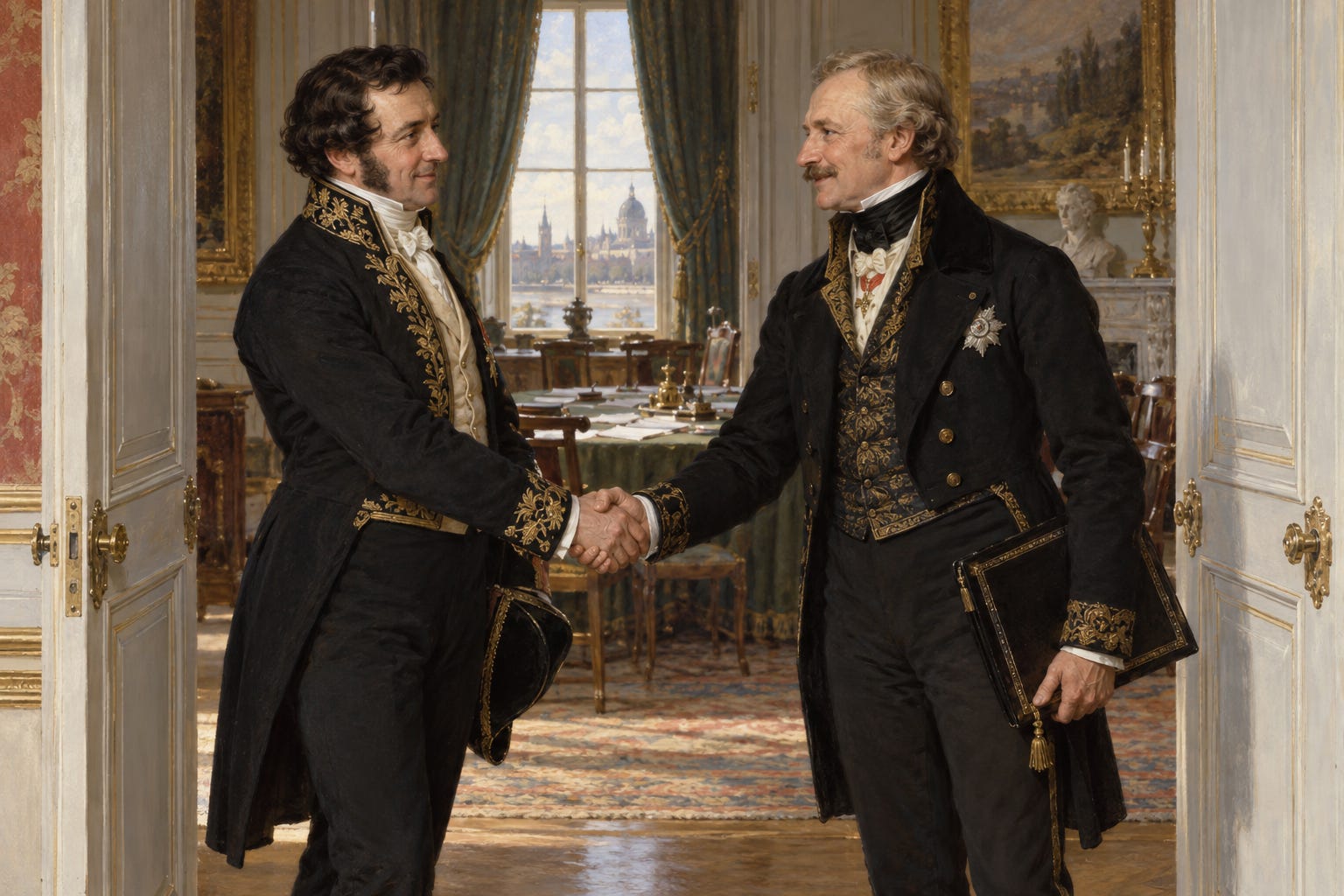
There is a curious tendency among some Orthodox Christians to regard any friendly encounter between an Orthodox hierarch and a non-Orthodox religious leader as evidence that something has gone terribly wrong. A patriarch meets with the Pope of Rome, photographs appear on social media, and almost immediately there are warnings about ecumenism, betrayal, and the impending surrender of the Orthodox faith. The meeting itself becomes the evidence. The conversation need not even be examined.
Mikhail Lermontov captured this way of thinking wonderfully in the preface to the second edition of A Hero of Our Time. He compares the Russian public to a provincial observer who overhears two diplomats from hostile governments speaking amicably and concludes that each must be betraying his country for the sake of their friendship. The observer cannot imagine that people who represent opposing interests might nevertheless speak respectfully, understand one another, and even enjoy one another’s company without abandoning their responsibilities.
The analogy reveals a problem of interpretation. We do not simply observe events; we interpret them through the expectations we bring with us. If we have already decided that dialogue is necessarily a betrayal of Orthodoxy, every cordial encounter will appear to confirm that judgment. The conclusion precedes the evidence.
Of course, diplomats sometimes betray their countries, and theologians sometimes compromise the faith. There is such a thing as false ecumenism. But cordiality is not capitulation, and conversation is not communion. Serious accusations about the fidelity of our bishops require attention to what they actually say and do, and to what the Church’s own tradition teaches about those separated from her.
That brings us to a more difficult question: Where does the Church end?
The Church is One
Orthodox Christians confess that the Church is one, holy, catholic, and apostolic. This is not merely an aspiration for future unity or a description of an invisible collection of people who happen to believe in Jesus. The Church is the Body of Christ, constituted and sustained by the Holy Spirit, gathered around her bishops, and manifested most fully in the celebration of the Eucharist.
We encounter this life in the Orthodox Church’s apostolic faith, sacraments, canonical order, and communion of bishops and faithful. We should affirm that fullness without embarrassment.
St. Ignatius of Antioch describes ecclesial life in relation to the bishop and the Eucharistic assembly. The faithful gather in communion with their bishop, sharing the one faith and the one Eucharist. This gives us a positive account of the Church’s unity.
But a positive account does not automatically answer every question about separated Christians. Identifying the fullness of ecclesial life is one task; determining the spiritual and sacramental consequences of every kind of separation is another.
Three questions therefore need to be distinguished. Can God act among people outside Orthodox communion? How should the Church understand sacramental acts performed in separated communities? What constitutes membership and full communion in the Church?
These questions are related, but an answer to one does not settle the others. A person may be moved by grace toward Christ without yet being incorporated into Orthodox communion. Recognition of a previous baptism does not amount to recognition of complete ecclesial unity. And the absence of Eucharistic communion does not, by itself, explain everything about the spiritual condition of those who are separated.
The Church’s history requires us to make these distinctions carefully.
Saints Cyprian and Stephen: An Ancient Disagreement
In the third century, St. Cyprian of Carthage and Pope St. Stephen of Rome disagreed sharply over the reception of Christians baptized in heretical and schismatic communities.
Cyprian’s ecclesiology was uncompromising. In On the Unity of the Catholic Church, he famously declared:
“He can no longer have God for his Father, who has not the Church for his mother.”
For Cyprian, the unity of the Church was inseparable from the unity of her sacramental life. Baptism belonged to the one Church of Christ. Those who had separated from her could not administer what they no longer possessed; consequently, those coming from such communities needed to receive baptism within the Church.
Stephen disagreed. His position survives principally through opponents who quoted and criticized it. He defended the practice of receiving those with a previous baptism through repentance and the laying on of hands, rather than baptizing them anew.
The disagreement concerned how fidelity to the one Church and the one baptism should govern reception. Both bishops took ecclesial unity seriously, but they drew different conclusions about the status of baptism administered during separation.
Their disagreement does not make doctrinal truth relative. It does show that the relationship between separation and sacramental reality was already a serious theological question within the ancient Church. We cannot adequately explain that history by assuming that every faithful bishop has always understood the matter in precisely the same way.
St. Basil and the Distinctions that Matter
St. Basil the Great provides a more differentiated account in his first canonical letter to Amphilochius, commonly known as Canon 1. He distinguishes heresy, schism, and unlawful assembly, or parasynagogue.
Heresy involves a departure from the faith itself. Schism concerns ecclesiastical disputes capable, in principle, of resolution. Unlawful assemblies arise when clergy or others establish unauthorized congregations in defiance of ecclesiastical discipline.
These distinctions affect how people are reconciled to the Church. Basil reports that earlier authorities treated the categories differently and accepted the baptism of some schismatics because they were understood as still belonging, in some sense, to the Church. He also acknowledges the stricter reasoning associated with Cyprian and Firmilian and recognizes differences in regional practice.
Basil’s account therefore requires more than the extraction of a convenient sentence. He preserves doctrinal seriousness, distinguishes among forms of separation, and considers how established practice should serve reconciliation.
Here we encounter a fundamental purpose of Orthodox canonical discipline: the salvation of human beings. The canons protect faith and order because these belong to the Church’s saving life. Their application requires attention both to what has gone wrong and to how it can be healed.
The distinction between akribeia and oikonomia belongs within this responsibility. Strict observance and pastoral economy are not competing allegiances, one to truth and the other to convenience. Economy must remain accountable to the Church’s faith, while canonical strictness must be exercised with attention to the people whose salvation is at stake.
Basil’s categories also warn against treating every separation as equivalent. A dispute over ecclesiastical authority and a rejection of the Trinity cannot simply be assigned the same theological significance.
Reconciliation and the Character of Separation
The Church’s practices of reception reflect this differentiated approach. Christians coming from separated communities have been received through baptism, chrismation, or profession of faith, depending on the community, circumstances, and ecclesiastical judgment involved.
The meaning of these practices has itself been debated. Some explanations emphasize recognition of a sacramental reality already present; others emphasize what reconciliation with the Church supplies. The variation establishes the need for discernment, even where it does not establish a single explanation of every reception.
An instructive example comes from the history of the Russian Orthodox Church Outside Russia and the Moscow Patriarchate. Their prolonged rupture in communion raised serious questions of ecclesiastical authority and fidelity. Yet Fr. Michael Pomazansky, writing within the ROCOR tradition in Orthodox Dogmatic Theology, refused to deny the grace of the mysteries celebrated by the Moscow Patriarchate. He distinguished temporary divisions of a non-dogmatic character from departures affecting the faith itself.
This example concerns a rupture within the Orthodox world. It cannot simply be transferred to every separated Christian confession. Its value is more specific: disrupted canonical communion does not necessarily mean that every spiritual bond has been severed or every sacramental act rendered empty.
Ukrainian ecclesiastical history raises related questions.
The Ukrainian Orthodox Church of the USA was received beneath the omophor of the Ecumenical Patriarchate in 1995; its unification with the Ukrainian Orthodox Church in America followed. Its hierarchy and faithful were received without repeating baptism or ordination.
In 2018, the Ecumenical Patriarchate likewise received appeals from the leaders and followers of the UOC-KP and UAOC, describing their separation as non-dogmatic and petitioning for the restoration of ecclesiastical communion. The Ecumenical Patriarchate then helped bring these communities together through the Unification Council in December 2018, which established the Orthodox Church of Ukraine, and granted the new Church its Tomos of Autocephaly in January 2019. While the authority and canonical basis of those actions remain disputed among Orthodox Churches, the point here is that the Ecumenical Patriarch treated them the way he treated the UOC-USA before and that Russian Orthodox Church treated the ROCOR.
These examples should be distinguished from another event many of us celebrate: the reception of numerous Evangelical Orthodox Church congregations into the Antiochian Orthodox Christian Archdiocese of North America in 1987. Their members were received through chrismation, and those chosen to serve as Orthodox clergy were ordained. A similar pattern marked the reception of Christ the Saviour Brotherhood communities into canonical Orthodox jurisdictions around 2000, and has also been followed in the reception of some former Anglican and Episcopalian congregations. In these cases, receiving members without baptism did not entail accepting their clergy’s previous ordinations. Recognition of baptism and recognition of holy orders are distinct ecclesiastical judgments.
Such examples demonstrate why reconciliation requires attention to the character of a separation and the authority responsible for addressing it. We should be cautious about demanding that contemporary bishops exercise less discernment than their predecessors.
The process can be disconcerting to those who expect everything to be perfectly tidy. In the short term, it can actually be quite messy.
What Follows—and What Remains Unresolved
Fr. Georges Florovsky examined sacramental recognition in his essay “The Limits of the Church” (1933). He questioned whether canonical boundaries necessarily coincide with the full reach of sacramental grace—the Church’s “charismatic” boundaries.
His concern was concrete. If the Church receives some Christians without baptizing them, how should their previous baptism be understood? Florovsky believed that an appeal to canonical separation alone did not adequately explain the Church’s practice.
Vladimir Lossky approaches ecclesial life through the intimate relationship between the Church and the Holy Spirit, drawing upon St. Irenaeus. His emphasis reminds us that an institutional description, however necessary, cannot exhaust the Church’s divine-human reality.
Metropolitan Kallistos Ware offers a related caution: we know where the Church is, but cannot be certain where she is not.
These are distinct theological reflections, not interchangeable dogmatic definitions of the Church’s boundaries. Florovsky addresses sacramental recognition, Lossky the Church’s life in the Spirit, and Ware restraint in judging separated Christians. Each must be read in context, rather than enlisted as a slogan to settle a contemporary dispute.
Together, however, their witness challenges an unwarranted inference: that because we can identify the fullness of Orthodox ecclesial life, we can also describe exhaustively everything Christ is accomplishing among separated Christians.
The Church is the ark of salvation because she is the Body of Christ. Salvation cannot be detached from Him. But our confession of what He has given the Church does not provide us with a complete account of every person He will save.
We know what Christ has given us. We do not know everything Christ may accomplish in others.
The Eucharist and the Reach of Intercession
The Eucharist makes another distinction visible.
The faithful gather around their bishop, or a priest serving with his blessing, to receive the Body and Blood of Christ. Eucharistic communion expresses a unity of faith and ecclesial life that must actually exist. Its boundaries matter and must be respected.
Yet the Divine Liturgy is offered for the life of the world. We pray for civil authorities, travelers, the sick, the suffering, captives, and the peace of the whole world. The Church’s intercession reaches beyond those standing in the building and beyond those eligible to approach the chalice.
We must distinguish between those who receive the Eucharist and those for whom the Church intercedes. Prayer for someone does not make that person a communicant. Nevertheless, the Church prays because she believes that God hears and acts.
This supports a claim about the reach of divine mercy and ecclesial intercession. It does not, by itself, establish the sacramental status or ecclesial membership of those for whom we pray. Keeping that distinction clear allows us to appreciate the breadth of the Church’s prayer without dissolving the particularity of her communion.
The Church’s canonical order is real, but God is not a prisoner of our categories. Aslan is not a tame lion.
Dialogue and Doctrinal Fidelity
These distinctions help clarify contemporary arguments about ecumenism.
St. Justin Popović’s description of ecumenism as a pan-heresy expresses a profound warning against approaches that displace the God-Man and relativize the uniqueness of His Church. That warning deserves serious attention. Institutional unity purchased through the abandonment of truth would betray the communion it claims to restore.
But the word ecumenism is used for markedly different things: doctrinal relativism, proposals for sacramental communion, theological dialogue, charitable cooperation, and ordinary meetings between religious leaders. Each requires its own evaluation.
Fr. Seraphim Rose, whose glorification ROCOR is now preparing, was himself a vigorous critic of ecumenism. Yet he recognized the danger of treating every contact as proof of heresy. In his defense of Fr. Dimitry Dudko, he distinguished a denial of Orthodoxy’s identity as the true Church from participation in discussions with other Christians.
We can criticize particular theological claims, questionable statements, and imprudent actions without assuming that every Orthodox bishop who participates in dialogue has betrayed the faith.
Conversations often explore what the Church has in common with other Christian communities. To a suspicious observer, that emphasis can look as though the participants have brushed aside their differences in pursuit of unwarranted communion. But identifying common ground does not, by itself, mean that unresolved differences have been dismissed.
A conversation about Roman primacy is not an agreement to accept papal supremacy. A discussion with Oriental Orthodox theologians about Christology must be judged by its account of Christ and the councils. Cooperation in protecting persecuted Christians must be assessed according to what that cooperation entails.
The relevant questions are specific: What was affirmed? What was denied? What commitments were made? Do they accord with the apostolic faith?
The Eastern Patriarchs’ encyclical of 1848 provides a useful historical example. It firmly rejected Roman claims the patriarchs regarded as departures from apostolic tradition, while expressing a desire for the healing of division. Doctrinal firmness and a desire for reconciliation belonged together.
The Holy and Great Council of Crete likewise affirmed theological dialogue while insisting upon fidelity to Orthodox faith. Its reception remains contested, but the distinction its documents make must still be examined on its merits.
Participation in dialogue does not establish uncertainty or ambivalence about our own faith. We may speak with others precisely because we believe the truth matters and desire that they should share in its fullness. That inquiry requires honest conversation, including the willingness to acknowledge disagreements that remain unresolved.
Reading the Canons without Turning Them into Weapons
The internet has made an extraordinary quantity of patristic and canonical material available. This is a blessing, but access to information is not the same thing as formation in wisdom.
A reader can extract a passage from Saints Cyprian, Basil, or Ignatius and imagine that he possesses a complete account of Orthodox ecclesiology. Another can extract a sentence from Florovsky or Ware and imagine that canonical boundaries no longer matter. Both substitute a fragment for the sustained work of interpretation.
St. Basil’s first canon is particularly instructive. It contains strict judgments, distinctions among separated groups, recognition of differing practices, and pastoral concern. Reading it faithfully requires holding these elements together.
The same discipline applies to contemporary criticism. We can identify errors without seeking the healing of those who hold them. We can condemn bishops without understanding the circumstances in which they are acting. We can turn concern for truth into an excuse for the suspicion, resentment, and division that our own Orthodox circles sometimes reward.
The irony is considerable. In the name of defending the unity of the Church, we can cultivate habits that make genuine unity more difficult.
Bishops can make mistakes; their decisions are accountable to the faith and canonical tradition of the Church. Fidelity may require questioning or resisting a particular decision. But criticism should identify the error, examine its circumstances, and objectively proportion its judgment to the evidence. A photograph of a cordial meeting cannot bear the weight of an accusation of heresy.
Nor is episcopal authority merely ceremonial. The Church entrusts bishops with responsibilities of judgment and reconciliation. Those responsibilities have limits, but they cannot be replaced by the confidence of a commentator who has collected quotations.
The purpose of canonical discipline is to preserve communion, correct disorder, and guide people toward salvation. Our use of the canons should serve those purposes too.
Confidence without Presumption
At the heart of this discussion is a temptation to make the Church’s uniqueness depend upon denying or demonizing every manifestation of grace beyond her visible communion.
The Orthodox Church does not become less fully the Body of Christ because the Holy Spirit prepares someone outside her communion to receive the Gospel. Acknowledging that separated Christians may love Christ and respond to grace does not require us to minimize their separation or the doctrinal differences that sustain it.
Indeed, if communion in the Orthodox Church is the blessing we confess it to be, we should desire that blessing for everyone. Separation should grieve us. It obstructs common witness and deprives Christians of the fullness of communion we desire to share.
That desire requires patience, respect, and honesty. We must neither conceal genuine differences nor presume that contempt will help resolve them. We cannot heal a division we refuse to discuss.
As I grow older, I find myself increasingly appreciative of the apophatic dimension of Orthodox theology. Our formulations are necessary, but they do not exhaust the reality they describe. This recognition calls for careful speech and reverence.
We confess the visible, sacramental fullness of the Orthodox Church. We also confess that God’s mercy exceeds our comprehension and that He desires the salvation of all. We should be able to affirm both without claiming to resolve the spiritual condition of every community or the eternal destiny of every person.
Some things have been clearly taught. Others require discernment informed by the Church’s history and practice. Still others remain within the judgment of God. Wisdom includes learning the difference.
The question “Where does the Church end?” can arise from a desire to understand communion and heal separation. It can also arise from a desire to identify people we may safely dismiss. We should examine the disposition with which we ask it.
The canons protect communion. The bishops preserve and administer it. The Eucharist manifests it. The Holy Spirit sustains it. And the Church’s mission is to invite all humanity into it.
We have been entrusted with an extraordinary treasury of faith, worship, and spiritual wisdom. Our responsibility is to preserve what we have received, live it faithfully, and welcome those whom Christ calls.
We should care for the Church’s boundaries because we treasure the life within them, rejoice that God’s grace is at work beyond them, and look for every opportunity that grace gives us to share this life with others.